Introduction
Ptosis, commonly known as droopy eyelid, is a condition where the upper eyelid falls lower than its normal position. While mild ptosis may seem like a cosmetic concern, significant drooping can obstruct vision and indicate underlying neurological, muscular, or structural issues. Early and accurate diagnosis of ptosis is essential for determining the right treatment plan and preventing long-term complications.
What Is Ptosis? Understanding the Basics Before Diagnosis
Ptosis affects the upper eyelid and may occur in one or both eyes. It can be
- Congenital, present from birth
- Acquired, developing later in life due to aging, trauma, nerve issues, or systemic diseases
A proper diagnosis of ptosis helps determine whether the condition is harmless or a sign of a serious underlying disorder such as Horner syndrome, myasthenia gravis, or third nerve palsy.
Why Accurate Diagnosis of Ptosis
Diagnosing ptosis is not just about identifying droopy eyelids; it involves pinpointing the root cause. Accurate diagnosis helps
- Prevent complications like impaired vision or eye strain
- Identify neurological or muscular disorders early
- Determine whether surgical correction is needed
- Tailor treatment based on severity and cause
Steps Involved in the Diagnosis of Ptosis
Diagnosing ptosis requires a structured approach that includes medical history assessment, physical examination, specialized tests, and sometimes imaging. Here’s a detailed look at each step
- Medical History Assessment :- The doctor begins by taking a detailed medical history. They may ask questions such as
- When did the eyelid drooping start?
- Is it constant, or does it worsen throughout the day?
- Do you have associated symptoms like double vision, headache, or eye pain?
- Any history of trauma or previous eye surgeries?
- Does ptosis run in the family?
- Do you experience weakness in other body parts?
This helps differentiate between muscle fatigue-related ptosis (e.g., myasthenia gravis) and structural ptosis caused by eyelid tissue problems.
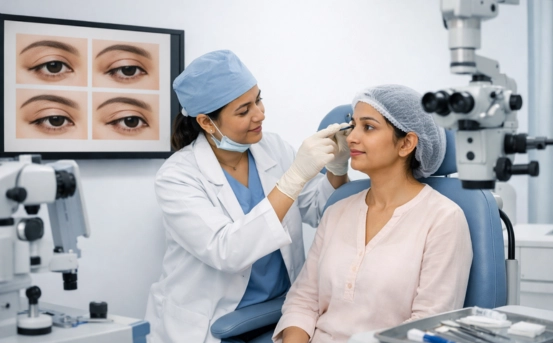
- Physical Examination of the Eyelids :- A thorough eyelid examination is the foundation of ptosis diagnosis. The ophthalmologist evaluates
- Eyelid Position :- The margin reflex distance (MRD1) is measured to determine how far the eyelid sits above the pupil. A decreased MRD1 confirms ptosis.
- Levator Muscle Function :- One of the most important tests, this assesses how well the levator palpebrae superioris muscle lifts the eyelid. Poor levator function suggests congenital causes or muscular dystrophy.
- Eyelid Crease Height :- Low crease height points to congenital ptosis, while a high crease may indicate aponeurotic (age-related) ptosis.
- Eyelid Fatigue Test :- Patients with myasthenia gravis often show increased drooping after prolonged upward gaze due to muscle fatigue.
- Vision & Eye Movement Tests :- To rule out neurological causes, the doctor may perform
- Visual Acuity Test :- Checks whether ptosis is affecting the patient’s ability to see clearly.
- Visual Field Test :- Measures how much the drooping eyelid is obstructing the upper field of vision.
- Extraocular Movement Exam :- Restrictions in eye movement may indicate third nerve palsy or brain abnormalities.
- The Ice Pack Test (For Myasthenia Gravis) :- This quick and non-invasive test helps diagnose ptosis caused by myasthenia gravis.
How it works
- An ice pack is placed on the eyelid for 2 minutes.
- If the eyelid position improves after cooling, it suggests a neuromuscular junction disorder.
Cooling improves nerve-muscle communication temporarily, which is characteristic of myasthenia gravis.
- Pharmacological Testing (For Horner Syndrome) :- If Horner syndrome is suspected, doctors use eye drops such as apraclonidine.
Positive result
- The droopy eyelid elevates
- The smaller (miotic) pupil dilates
This indicates sympathetic nerve pathway involvement.
- Slit-Lamp Examination :- This test allows detailed evaluation of
- Eyelid structure
- Corneal health
- Tear film quality
It helps identify associated eye surface disorders or hidden abnormalities.
- Imaging Tests for Complex Cases :- If the doctor suspects a neurological or structural abnormality, imaging may be recommended.
- MRI Scan :- Used to assess
- Brain tumors
- Aneurysms
- Nerve compression
- Neuromuscular disorders
- CT Scan :- Helps evaluate trauma, bone fractures, or orbital tumors.
- Ultrasound (B-Scan) :- Used for soft-tissue assessment when tumors or cysts are suspected.
- Blood Tests for Underlying Disorders :- Blood tests may be ordered to detect
- Autoimmune diseases (e.g., antibodies for myasthenia gravis)
- Thyroid dysfunction
- Diabetes (which can affect nerve function)
These tests help rule out systemic causes of ptosis.
- Photography for Baseline Documentation :- Clinical photographs help
- Compare eyelid position over time
- Monitor ptosis progression
- Plan surgical treatment if needed
These images become part of the patient’s medical records for future reference.
- Pediatric Ptosis Diagnosis: Special Considerations :- Diagnosing ptosis in children requires a different approach. Pediatric ptosis can affect vision development, leading to lazy eye (amblyopia). Doctors check
- Visual milestones
- Eye alignment
- Early signs of astigmatism or refractive errors
Prompt diagnosis is crucial to prevent long-term vision problems in children.
When Should You See a Doctor for Ptosis?
Seek medical attention if
- Ptosis develops suddenly
- You experience double vision or severe headaches
- The eyelid drooping worsens over time
- A child’s eyelid droops significantly
- There is trauma or infection around the eye
Sudden ptosis can indicate a neurological emergency and requires immediate evaluation.
How Diagnosis Influences Treatment
Once the cause of ptosis is identified, treatment is tailored accordingly
- Muscle disorders medication or supportive therapy
- Nerve damage neurological treatment
- Age-related ptosis eyelid surgery (levator advancement)
- Congenital ptosis early surgical correction
Accurate diagnosis ensures effective and targeted treatment, restoring both eyelid function and appearance.
Conclusion
Diagnosing ptosis involves a systematic combination of medical history, detailed eye examination, specialized tests, and imaging when necessary. Because ptosis can sometimes signal serious neurological or systemic issues, early and thorough evaluation is essential. With timely diagnosis, most cases of ptosis can be treated successfully, restoring clear vision and improving quality of life.