Introduction
Kidney transplant is one of the most effective treatments for people with end-stage renal disease (ESRD). It offers better survival, improved quality of life, and greater freedom compared to dialysis. With advances in medical science, multiple types of kidney transplant procedures are available today, each designed to improve outcomes and meet the unique needs of patients. Understanding these transplant types helps patients and their families make informed decisions.
Types of Kidney Transplant
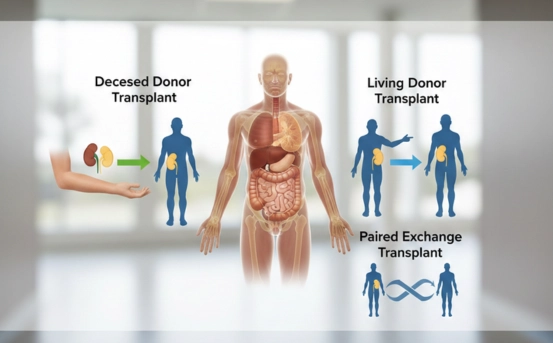
- Living Donor Kidney Transplant :- A living donor kidney transplant is when a healthy individual donates one of their kidneys to a patient in need. Humans are born with two kidneys but can live a healthy life with just one, making living donation an excellent option.
Types of Living Donors
- Related Living Donor: A family member such as a parent, sibling, or child donates a kidney. The genetic similarity often increases the chances of a successful match.
- Unrelated Living Donor: A friend, spouse, or volunteer donor provides the kidney. Modern immunosuppression makes unrelated donor transplants very successful.
- Paired Kidney Donation (Swap Transplant): If the donor and recipient are incompatible, they are matched with another incompatible donor-recipient pair. Each donor gives a kidney to the other recipient, ensuring compatibility.
Benefits of Living Donor Kidney Transplant
- Shorter waiting time.
- Better long-term survival and kidney function.
- Planned surgery, reducing stress and complications.
- Higher success rates compared to deceased donor transplants.
- Deceased Donor Kidney Transplant :- A deceased donor kidney transplant uses a kidney donated by someone who has recently passed away. These organs become available through national organ donation programs.
Types of Deceased Donor Organs
- Standard Criteria Donor (SCD): Healthy donors under the age of 60 with no major medical conditions.
- Expanded Criteria Donor (ECD): Donors over 60 or those with certain health conditions like hypertension. These kidneys may have slightly shorter longevity but still provide life-saving treatment.
- Donation After Circulatory Death (DCD): Kidneys recovered after the donor’s heart stops beating. Advances in preservation have improved outcomes significantly.
Benefits of Deceased Donor Kidney Transplant
- A life-saving option for patients without a living donor.
- Advanced techniques like machine perfusion improve organ viability.
- Increased awareness of organ donation is expanding the donor pool worldwide.
- ABO-Incompatible Kidney Transplant :- Normally, blood type compatibility is essential for a transplant. However, ABO-incompatible kidney transplants allow recipients to receive a kidney from a donor with a different blood group.
How It Works :- Before the transplant, the patient undergoes special treatments
- Plasmapheresis to remove anti-blood group antibodies.
- Immunosuppressive medications to prevent rejection.
- IVIG therapy to support immune system conditioning.
Benefits
- More donor options, reducing wait time.
- High success rates at advanced transplant centers.
This type is especially helpful in countries with long deceased donor waiting lists.
- Preemptive Kidney Transplant :- A preemptive kidney transplant is performed before the patient starts dialysis. It is considered the best approach whenever possible.
Why Preemptive Transplant Is Superior
- Helps patients avoid complications of long-term dialysis.
- Improves survival and long-term graft function.
- Enhances the patient’s quality of life.
- Often requires early referral to a kidney specialist for evaluation.
Most preemptive transplants involve living donors due to better planning and timing.
- Kidney Transplant with High PRA (Sensitized Patients) :- Patients with a high panel reactive antibody (PRA) have strong immune responses, making it difficult to find compatible donors. These patients may develop antibodies due to
- Previous transplants
- Blood transfusions
- Pregnancy
Special Techniques Used
- Desensitization therapy
- Plasmapheresis
- Immunomodulators
Benefits :- Such advanced protocols allow even highly sensitized patients to successfully undergo transplantation, greatly improving access to donor organs.
- Dual Kidney Transplant :- In some cases, two kidneys from a deceased donor are transplanted into a single recipient. This is known as a dual kidney transplant.
Why Dual Kidneys Are Used
- Kidneys from older donors or those with mild impairment may not function optimally alone.
- Transplanting both kidneys ensures better overall function.
Benefits
- Expands the donor pool.
- Provides excellent kidney function when single-kidney performance may be inadequate.
- Domino Kidney Transplant :- A domino kidney transplant involves a chain of transplants triggered by a single altruistic donor. For example
- Donor A donates to Recipient B (compatible)
- Recipient B’s incompatible donor donates to Recipient C
This chain can help many patients who might otherwise wait years for a suitable kidney.
Advantages
- Helps multiple patients receive transplants quickly.
- Ideal for those without a compatible donor.
- Robotic Kidney Transplant :- Many advanced centers now perform robotic-assisted kidney transplantation. The procedure uses minimally invasive robotic technology to place the kidney with smaller cuts and greater precision.
Benefits of Robotic Kidney Transplantation
- Reduced pain and blood loss
- Smaller scars
- Faster recovery and shorter hospital stay
- Ideal for obese or complex-case patients
Which Type of Kidney Transplant Is Right for You?
The best type of kidney transplant depends on several factors, including
- Medical history and kidney disease stage
- Availability of living donors
- Blood type and antibody levels
- Urgency of treatment
- Overall health and eligibility
A transplant team including nephrologists, surgeons, and transplant coordinators conducts thorough evaluations to determine the safest and most effective option.
Conclusion
Advancements in kidney transplantation have given patients multiple pathways to regain a healthy, active life. Whether through living donors, deceased donors, ABO-incompatible transplant, or robotic surgery, the choice depends on individual needs and medical suitability. Understanding each type empowers patients to make confident decisions and seek timely care.