Introduction
Bipolar hemiarthroplasty is a highly effective surgical procedure used to treat severe hip damage, especially in elderly patients suffering from femoral neck fractures, arthritis, or avascular necrosis. Unlike total hip replacement, this surgery replaces only the femoral head while keeping the natural hip socket (acetabulum) intact. What makes it unique is the bipolar design, a dual-bearing system that allows two points of movement, offering smoother mobility and greater comfort after surgery.
Over the years, advancements in medical science have introduced multiple types of bipolar hemiarthroplasty surgery. Each technique is chosen based on the patient’s age, bone condition, fracture type, and long-term mobility goals. This detailed guide explains the various types of bipolar hemiarthroplasty surgeries, their benefits, how they differ, and what patients can expect.
Types of Bipolar Hemiarthroplasty Surgery
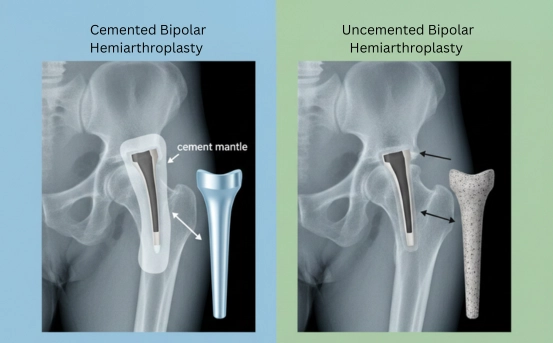
- Cemented Bipolar Hemiarthroplasty :- Cemented bipolar hemiarthroplasty is the most commonly performed type in elderly patients with weaker bones. In this method, a special medical-grade bone cement is used to fix the femoral stem securely into the thigh bone (femur).
The cement acts as a stabilizing material, offering immediate rigidity and support, which is particularly useful for individuals with osteoporosis or compromised bone strength.
Key features
- Provides excellent early stability
- Reduces postoperative pain faster
- Allows weight-bearing sooner
- Ideal for elderly patients with low bone density
- Lower risk of implant loosening in the short term
Cemented hemiarthroplasty is widely trusted because it reduces the chances of implant movement, thereby improving recovery time and restoring mobility quickly.
- Uncemented Bipolar Hemiarthroplasty :- Uncemented or cementless bipolar hemiarthroplasty is performed using a specially designed femoral stem that has a porous coating. This coating allows natural bone to grow into the implant, securing it over time without the need for cement. This method is better suited for younger patients with strong bones that can support long-term biological fixation.
Key features
- Bone grows and fuses naturally with the implant
- Reduces risk of cement-related complications
- Suitable for active and younger patients
- Long-term durability is often higher
- Requires good bone quality for successful outcomes
While uncemented implants may take longer to stabilize completely, they can last for decades when performed on the right candidate.
- Monopolar vs. Bipolar Hemiarthroplasty :- Although the focus is on bipolar hemiarthroplasty, it is important to understand how it differs from monopolar procedures. Monopolar implants have a single point of motion between the prosthetic head and the acetabulum. In contrast, bipolar implants offer two points of movement, one between the inner ball and outer shell of the implant and another between the implant and the natural socket.
Why bipolar is preferred
- Reduces wear and tear on the natural joint
- Improves range of motion
- Minimizes the risk of dislocation
- Offers smoother, more natural movement
- Reduces friction within the hip joint
This dual-mobility feature is what makes bipolar hemiarthroplasty ideal for elderly or low-demand patients who require comfort and stability.
- Posterior Approach Bipolar Hemiarthroplasty :- The posterior approach is one of the most traditional and widely used surgical routes. Surgeons access the hip joint through an incision made at the back of the hip, navigating between the gluteus maximus and short external rotator muscles.
Key features
- Provides excellent visibility of the hip joint
- Easier for surgeons to position the implant accurately
- Lower risk of damaging the abductor muscles
- Shorter incision time compared to other approaches
Although effective, this technique carries a slightly higher risk of postoperative dislocation. However, with modern bipolar implants and enhanced rehabilitation, this risk has significantly reduced.
- Anterior Approach Bipolar Hemiarthroplasty :- The anterior approach is a muscle-sparing technique where the surgeon accesses the hip joint from the front. This method avoids cutting major muscles, leading to a faster and less painful recovery.
Key features
- Minimally invasive and muscle-sparing
- Less postoperative pain
- Faster recovery and early mobility
- Lower risk of dislocation
- Better functional outcomes in the short term
Because fewer muscles are disturbed during surgery, patients often experience reduced limping and regain mobility earlier compared to the posterior approach.
- Lateral (Transgluteal) Approach Bipolar Hemiarthroplasty :- In this technique, the surgeon enters the hip joint from the side through the gluteal muscles. This method offers a balance between visibility and stability.
Key features
- Reduced dislocation rate
- Good stability for elderly patients
- Suitable for patients with neurological issues
- Offers good access for fracture management
The lateral approach is particularly beneficial for patients with complex fractures or those at higher risk of falls.
- Modular Bipolar Hemiarthroplasty :- Modular bipolar implants come with interchangeable components such as different head sizes, stem lengths, and cup designs. This customization allows the surgeon to tailor the implant to the patient’s anatomy for better comfort and improved function.
Key features
- Custom-fit design improves accuracy
- Allows better balancing of leg length
- Reduces postoperative complications
- Useful for patients with anatomical variations
- Offers superior long-term stability
Modular implants are widely used in modern orthopedic surgeries due to their flexibility and patient-specific options.
- Non-Modular Bipolar Hemiarthroplasty :- Non-modular or fixed bipolar implants come in a single-piece system without interchangeable components. While less customizable, they are durable, simple, and cost-effective.
Key features
- Simple design with fewer mechanical parts
- Reduced chance of mechanical failure
- Ideal for low-demand elderly patients
- Lower overall cost
- Reliable and long-lasting
Although non-modular implants are less flexible, they offer excellent longevity and effectiveness for elderly patients requiring straightforward hip repair.
Conclusion
Bipolar hemiarthroplasty is a highly successful and safe surgical option for restoring mobility and reducing pain in patients with hip fractures or degenerative conditions. With multiple surgical types cemented, uncemented, posterior approach, anterior approach, lateral approach, modular, and non-modular doctors can choose the most appropriate technique based on patient needs, age, bone strength, and activity levels.
Understanding the types of bipolar hemiarthroplasty helps patients and caregivers make informed decisions and prepare better for surgery and recovery. Regardless of the type chosen, early diagnosis, skilled surgical expertise, and proper rehabilitation all contribute to excellent outcomes and restored quality of life.