





Introduction
Bipolar hemiarthroplasty is a surgical procedure most commonly performed to treat severe hip damage, particularly in elderly patients suffering from displaced femoral neck fractures or advanced degenerative hip joint conditions. But before the surgery is planned, a careful and accurate diagnosis is essential. Diagnosis plays a crucial role in determining whether a patient truly needs bipolar hemiarthroplasty or if another treatment option may be more beneficial.
Understanding Bipolar Hemiarthroplasty
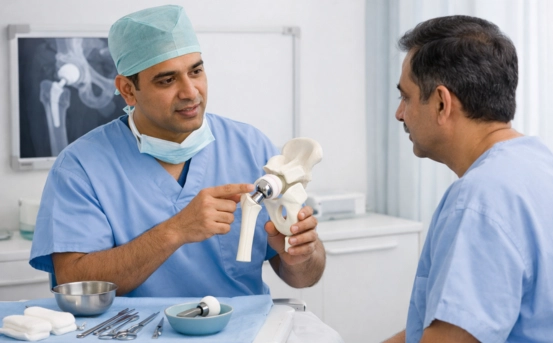
Bipolar hemiarthroplasty is a partial hip replacement procedure where the damaged femoral head is removed and replaced with a prosthetic implant that has two bearings one inside the prosthetic head and one between the prosthetic head and the acetabulum. This design helps reduce wear, allows smoother movement, and improves patient outcomes. But determining when this surgery is necessary requires in-depth diagnostic evaluation.
Why Diagnosis Matters Before Bipolar Hemiarthroplasty
Accurate diagnosis ensures
- The surgery is required and not avoidable
- The cause of hip damage is clearly identified
- The right type of implant is selected
- Patient-specific risk factors are evaluated
- Post-surgical outcomes are predictable
Diagnosis also helps differentiate between conditions requiring total hip replacement, open reduction internal fixation, or conservative management.
Diagnosis of Bipolar Hemiarthroplasty Surgery
- Initial Clinical Evaluation :- Diagnosis typically begins with a detailed clinical assessment. Doctors carefully analyze the patient’s symptoms, mobility limitations, and injury history.
Common symptoms that lead to evaluation
- Sudden hip pain after a fall or accident
- Inability to bear weight on the leg
- Shortening or external rotation of the affected limb
- Severe stiffness and restricted hip movement
- Pain that worsens with attempts to walk
Medical history review includes
- Previous hip injuries
- Osteoporosis status
- Chronic joint diseases
- Medication and surgical history
- Comorbidities (diabetes, cardiac issues, etc.)
This initial evaluation helps the surgeon form a preliminary understanding of the condition before proceeding to imaging tests.
- Physical Examination of the Hip :- A thorough physical examination is a vital part of diagnosis. Doctors assess the hip by checking
- Range of Motion :- The surgeon evaluates active and passive movements. Reduced mobility or a grinding sensation often indicates severe joint damage.
- Leg Alignment :- Shortening of the affected limb or altered alignment typically points to a fracture or femoral head collapse.
- Hip Stability :- Instability or excessive movement suggests joint compromise that may require surgical intervention.
- Localized Pain Assessment :- Pressure applied over specific areas can help confirm fracture sites or degenerative changes.
Physical examination findings guide the surgeon toward the next diagnostic step: imaging.
- Imaging Tests for Confirming the Need for Bipolar Hemiarthroplasty
- X-Rays (Primary Diagnostic Tool) :- X-rays are the first and most important imaging test. They help assess
- Displaced femoral neck fractures
- Severity of bone displacement
- Joint space narrowing
- Bone quality and density
- Presence of osteoarthritis or avascular necrosis
A displaced fracture in elderly patients is one of the strongest indicators for bipolar hemiarthroplasty.
- CT Scan :- A CT scan provides a detailed 3D view of the hip joint. Doctors may recommend it when
- X-rays are unclear
- The fracture pattern is complex
- Bone fragments need precise evaluation
- Planning implant alignment
CT scanning helps surgeons understand the exact damage before selecting implant size or fixation technique.
- MRI Scan :- While MRI is not always needed for fractures, it is essential in diagnosing
- Early avascular necrosis (AVN)
- Cartilage damage
- Soft tissue injuries
- Occult (hidden) fractures
MRI helps determine whether hemiarthroplasty or total hip replacement is more suitable.
- Bone Density Scan (DEXA) :- Used to evaluate bone strength, especially in older adults with osteoporosis. Low bone density increases fracture risk and influences implant choice.
- Laboratory Tests and Pre-Operative Assessment :- Although diagnosis primarily depends on clinical and imaging evaluations, laboratory tests help determine a patient’s suitability for surgery.
Important tests include
- Complete Blood Count (CBC) :- checks for anemia or infection
- Blood Sugar Levels :- important for diabetic patients
- Kidney and Liver Function Tests :– ensures safe anesthesia administration
- Coagulation Profile :– assesses bleeding/clotting risk
- Electrolyte Levels :– ensures body balance before surgery
These tests help reduce surgical complications and improve postoperative recovery.
- Determining If Bipolar Hemiarthroplasty Is the Right Choice :- Surgeons choose bipolar hemiarthroplasty based on specific clinical criteria.
- Ideal Candidates Include
- Elderly patients (>65 years) with displaced femoral neck fractures
- Patients with poor bone quality
- Individuals with limited mobility levels before the injury
- Patients without major acetabular cartilage damage
- Cases where fusion or internal fixation is unlikely to succeed
- Conditions That Strongly Indicate Surgery
- Severe displacement of femoral head
- Intracapsular fractures with high risk of non-union
- AVN with femoral head destruction
- Progressive hip arthritis combined with fracture
- When Bipolar Hemiarthroplasty Is Preferred Over Total Hip Replacement:
- In older adults with low physical demands
- When acetabular cartilage is relatively preserved
- When reducing dislocation risk is a priority
- When surgical time must be minimized
- Differential Diagnosis :- Before confirming bipolar hemiarthroplasty, doctors also rule out other hip-related conditions.
- Conditions considered in differential diagnosis
- Hip dislocation
- Intertrochanteric fractures
- Pelvic fractures
- Severe osteoarthritis requiring THR
- Labral tears
- Hip impingement syndrome
This step ensures accurate treatment selection.
- Functional Assessment and Mobility Evaluation :- Doctors also evaluate the patient’s overall functional status before recommending surgery.
- Common tests include
- Ability to stand or walk
- Gait analysis
- Muscle strength assessment
- Balance and coordination tests
- Pain scoring (VAS scale)
These evaluations help predict postoperative outcomes and recovery speed.
- Multidisciplinary Consultation :- In complex cases, diagnosis and surgical planning involve a team:
- Orthopedic surgeons
- Radiologists
- Anesthesiologists
- Geriatric specialists
- Physiotherapists
This ensures that the patient receives a well-rounded evaluation before proceeding.
Conclusion
Diagnosis of the need for bipolar hemiarthroplasty surgery is a thorough process involving clinical evaluation, physical examination, imaging tests, lab assessments, and multi-specialty review. Accurate diagnosis ensures that patients receive the right treatment at the right time, improving mobility, reducing pain, and restoring independence. By identifying fractures, joint damage, and functional limitations early, surgeons can plan the best possible surgical approach, ensuring successful outcomes and long-term hip stability.



