Introduction
Cheek implants, also known as malar or mid-face implants, are a popular cosmetic procedure designed to enhance facial contours, restore youthful fullness, and improve symmetry. With the growing demand for facial aesthetic enhancement, understanding the different types of cheek implant surgery can help you make informed decisions.
What Are Cheek Implants?
Cheek implants are biocompatible materials inserted into the cheek area to enhance the structure and projection of the mid-face. They can improve the appearance of flat cheeks, underdeveloped cheekbones, or age-related sagging. Unlike fillers, which provide temporary results, cheek implants offer long-lasting outcomes, giving a more defined and youthful look. Cheek implant surgery can also correct asymmetry, enhance facial harmony, and complement other facial procedures like rhinoplasty or jawline surgery.
Types of Cheek Implant Surgery
Cheek implant surgery can vary based on material, placement, and technique. Understanding these types will help you choose the option that best suits your facial structure and aesthetic goals.
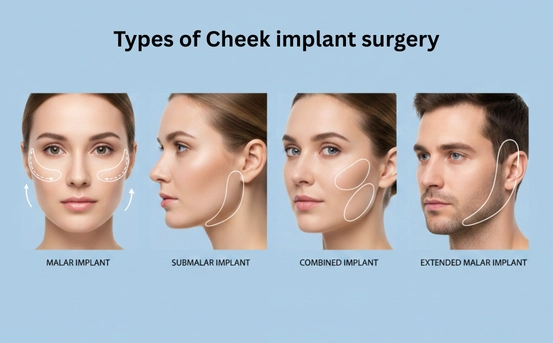
- Submalar Implants :- Submalar implants are designed to enhance the lower part of the cheek, providing volume to areas that may appear hollow or sunken. This type is especially useful for patients with age-related volume loss in the mid-face.
Key features:
- Improves under-eye hollows and nasolabial folds
- Adds natural-looking volume to the mid-cheek area
- Ideal for restoring youthful fullness
Procedure:
Submalar implants are typically inserted through an intraoral incision, leaving no visible scars. They are positioned over the cheekbone and secured in place to achieve the desired contour.
Benefits:
- Natural-looking enhancement
- Long-lasting results
- Can be combined with other facial surgeries
- Malar Implants :- Malar implants focus on augmenting the cheekbone area, creating a more pronounced and structured facial appearance. They are perfect for patients seeking high cheekbones or improved facial definition.
Key features:
- Enhances cheekbone prominence
- Adds symmetry and balance to the face
- Suitable for both men and women
Procedure:
Malar implants are usually inserted via an intraoral incision or sometimes a small incision under the eyelid. The implant is secured over the cheekbone to enhance projection.
Benefits:
- Provides a more sculpted look
- Complements other cosmetic procedures like jawline contouring
- Permanent results
- Combined Malar-Submalar Implants :- For patients seeking full mid-face augmentation, combined malar-submalar implants are recommended. This approach enhances both the upper and lower cheek regions, offering a complete facial transformation.
Key features:
- Corrects mid-face flattening and hollows
- Adds overall facial symmetry
- Restores youthful contours in aging faces
Procedure:
These implants are strategically placed to augment the cheekbone and submalar regions. Surgeons ensure the implants blend seamlessly with the natural facial structure.
Benefits:
- Comprehensive facial enhancement
- Balanced and harmonious results
- Can dramatically improve overall facial aesthetics
- Custom Cheek Implants :- Custom cheek implants are tailored to the patient’s facial anatomy using 3D imaging technology. These implants are ideal for patients with unique facial structures, asymmetry, or complex aesthetic goals.
Key features:
- Personalized design for perfect fit
- Corrects asymmetry or deformities
- Enhances both projection and width of the cheeks
Procedure:
Using a CT scan or 3D imaging, surgeons design implants that match the patient’s facial contours. Custom implants are then inserted through small incisions and secured in place.
Benefits:
- Completely personalized outcome
- Ideal for reconstructive cases
- Long-lasting, natural-looking results
- Silicone Cheek Implants :- Silicone is one of the most commonly used materials for cheek implants. It is durable, flexible, and biocompatible, making it a safe choice for long-term results.
Key features:
- Smooth or textured surface
- Easily shaped and positioned
- Available in various sizes and projections
Procedure:
Silicone implants are inserted through an intraoral or transconjunctival incision and positioned over the cheekbone. They are secured to prevent shifting and ensure symmetry.
Benefits:
- Reliable and predictable results
- Non-reactive and safe material
- Can be removed or replaced if desired
- Gore-Tex Cheek Implants :- Gore-Tex (ePTFE) implants are soft, flexible, and porous, allowing tissue integration. They are often chosen for patients looking for a natural feel and appearance.
Key features:
- Soft and flexible texture
- Integrates with surrounding tissues
- Reduces risk of implant migration
Procedure:
Gore-Tex implants are inserted similarly to silicone implants. Over time, tissue grows into the porous surface, creating a more natural and stable enhancement.
Benefits:
- Natural feel under the skin
- Reduced risk of shifting or rotation
- Long-lasting and biocompatible
- Fat Grafting as an Alternative :- Although technically not an implant, autologous fat grafting can also enhance the cheeks. Fat is harvested from another part of the patient’s body and injected into the mid-face to add volume.
Key features:
- Uses the patient’s own fat
- Minimally invasive technique
- Temporary but natural-looking results
Procedure:
Fat is collected via liposuction, purified, and carefully injected into the cheeks. Multiple sessions may be required for optimal results.
Benefits:
- Natural enhancement with no foreign material
- Can improve skin texture
- Can be combined with other facial procedures
Recovery and Aftercare
Recovery after cheek implant surgery varies based on the type and extent of the procedure. Typically:
- Swelling and bruising last 1–2 weeks
- Mild discomfort is managed with pain medications
- Return to normal activities within 1–2 weeks
- Full results visible after 4–6 weeks
Patients should follow all post-operative instructions, including avoiding strenuous activities, maintaining oral hygiene (for intraoral incisions), and attending follow-up appointments to ensure proper healing.
Risks and Considerations
While cheek implant surgery is generally safe, potential risks include:
- Infection
- Implant shifting or displacement
- Asymmetry
- Temporary numbness or swelling
Choosing a board-certified cosmetic or maxillofacial surgeon with experience in facial implants reduces the likelihood of complications and ensures optimal results.
Conclusion
Cheek implant surgery offers multiple options for enhancing facial aesthetics, restoring volume, and achieving youthful contours. From malar and submalar implants to customized designs and Gore-Tex implants, each type serves specific needs and goals. Understanding the differences can help patients make informed choices and achieve natural-looking, long-lasting results.