Introduction
The kidneys are vital organs responsible for filtering blood, maintaining fluid balance, and regulating blood pressure. Any disruption in their vascular or non-vascular structures can lead to significant health issues. Renal interventions, whether vascular or non-vascular, play a crucial role in managing kidney-related diseases. Accurate diagnosis is the foundation of successful renal interventions, helping clinicians decide on the most effective treatment plan for patients.
Understanding Diagnosis of Vascular and Non-Vascular Renal Interventions
Renal interventions are categorized into two main types: vascular and non-vascular.
- Vascular renal interventions :- It involve procedures targeting the blood vessels of the kidney. These interventions are critical in cases of renal artery stenosis, aneurysms, arteriovenous malformations, or traumatic injuries affecting renal circulation. Common vascular interventions include angioplasty, stent placement, embolization, and renal artery bypass surgery.
- Non-vascular renal interventions :- It target the renal parenchyma, collecting system, or urinary tract without directly involving blood vessels. These procedures address kidney stones, tumors, cysts, and infections. Techniques may include percutaneous nephrostomy, biopsy, ablation, lithotripsy, and ureteral stenting.
The accurate diagnosis of these conditions is essential to determine whether a vascular or non-vascular approach or a combination of both is required.
Diagnostic Techniques for Vascular Renal Interventions
Diagnosing vascular conditions in the kidneys involves advanced imaging modalities to assess the renal arteries, veins, and microvascular structures.
- Doppler Ultrasound :- Doppler ultrasound is a non-invasive technique that measures blood flow velocity and detects vascular abnormalities. It is particularly useful for identifying renal artery stenosis, thrombosis, or arteriovenous malformations. Doppler imaging can quantify flow dynamics, helping physicians decide on intervention strategies such as angioplasty or stenting.
- Computed Tomography Angiography (CTA) :- CTA combines CT imaging with contrast material to produce detailed 3D images of the renal vasculature. It allows visualization of arterial narrowing, aneurysms, or vascular tumors. CTA is often preferred for pre-interventional planning because it provides comprehensive anatomical information.
- Magnetic Resonance Angiography (MRA) :- MRA is an excellent alternative for patients with impaired renal function, as it may avoid iodinated contrast agents. MRA provides high-resolution images of renal vessels and is helpful in evaluating congenital anomalies, fibromuscular dysplasia, and complex aneurysms.
- Digital Subtraction Angiography (DSA) :- DSA remains the gold standard for vascular renal diagnostics. It provides dynamic imaging of renal arteries and veins in real-time, allowing both diagnosis and immediate interventional procedures, such as embolization or stent placement, in the same session.
- Laboratory and Functional Assessments :- Beyond imaging, laboratory tests such as serum creatinine, estimated glomerular filtration rate (eGFR), and urinary biomarkers are essential. Functional studies, including renography with radiotracers, assess the impact of vascular abnormalities on kidney function.
Diagnostic Techniques for Non-Vascular Renal Interventions
Non-vascular renal interventions require precise imaging to localize lesions, stones, or infections within the kidney parenchyma or collecting system.
- Ultrasound :- Ultrasound is often the first-line imaging tool for evaluating kidney size, cysts, stones, and tumors. Its real-time capabilities allow guidance for percutaneous procedures such as biopsies and nephrostomy placement.
- Computed Tomography (CT) :- CT scans, including non-contrast and contrast-enhanced studies, provide detailed information about renal masses, stones, and trauma-related injuries. CT urography is particularly useful in evaluating the urinary tract, helping guide interventions like ureteral stenting or lithotripsy.
- Magnetic Resonance Imaging (MRI) :- MRI offers high-resolution images of renal parenchyma and tumors without ionizing radiation. Techniques like diffusion-weighted imaging and MR urography are valuable for characterizing masses, cysts, or obstructions.
- Nuclear Medicine Studies :- Radionuclide imaging evaluates renal function and drainage patterns. These studies are essential for planning interventions such as nephrostomy or reconstructive procedures, especially in cases of congenital abnormalities or obstruction.
- Endoscopic and Fluoroscopic Evaluation :- Endoscopic techniques like ureteroscopy, combined with fluoroscopy, allow direct visualization of stones, strictures, or tumors within the urinary tract. They often serve both diagnostic and therapeutic purposes.
Combined Vascular and Non-Vascular Considerations
Many renal conditions require an integrated diagnostic approach, as vascular and non-vascular factors may coexist. For example, renal tumors often involve nearby blood vessels, requiring both angiography and CT/MRI evaluation before intervention. Similarly, trauma cases may necessitate assessment of both vascular injuries and urinary tract damage.
Effective diagnosis in such cases ensures:
- Precise localization of the lesion or abnormality.
- Assessment of function, determining whether renal preservation is feasible.
- Risk evaluation, identifying potential complications before intervention.
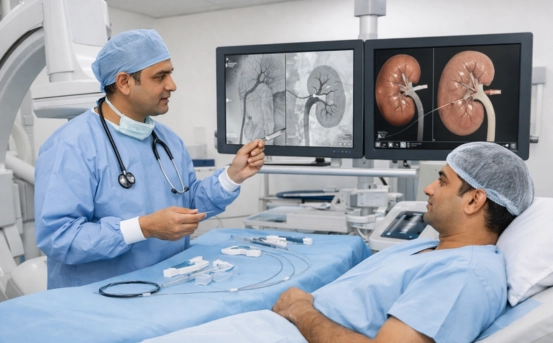
Modern interventional radiology units combine these imaging techniques, allowing multi-disciplinary teams to plan tailored, minimally invasive procedures for each patient.
The Role of Technology in Enhancing Diagnosis
Advances in imaging technology and software have significantly improved the diagnosis of renal conditions. Three-dimensional reconstruction, fusion imaging, and AI-assisted detection enhance accuracy and reduce procedural risks.
- 3D reconstruction allows clinicians to visualize the renal anatomy from multiple angles, improving pre-surgical planning.
- Fusion imaging combines real-time ultrasound with pre-acquired CT or MRI data, aiding in precise needle placement during biopsies or ablation procedures.
- AI and machine learning help detect subtle abnormalities, differentiate between benign and malignant lesions, and predict vascular complications.
These technologies not only improve diagnostic accuracy but also enhance patient safety and procedural outcomes.
Conclusion
The diagnosis of vascular and non-vascular renal conditions is a complex yet critical aspect of modern nephrology and interventional radiology. Accurate and timely diagnostic evaluation ensures the appropriate selection of interventions, minimizing complications and preserving renal function.
From Doppler ultrasound to advanced CT, MRI, and angiographic techniques, each diagnostic tool plays a crucial role in mapping the vascular and non-vascular landscape of the kidneys. Integrated approaches and technological innovations further empower clinicians to offer personalized, minimally invasive, and effective treatments.
Early detection, precise imaging, and comprehensive evaluation are key to successful renal interventions, improving patient outcomes and enhancing quality of life. Whether it’s managing renal artery stenosis, kidney stones, tumors, or congenital anomalies, accurate diagnosis is the first step toward effective treatment.