Introduction
Orchidopexy is one of the most common pediatric surgeries performed to correct undescended testis (cryptorchidism). While the procedure itself is simple and safe, early and accurate diagnosis is crucial. Detecting an undescended testicle in time ensures proper growth, prevents fertility issues later in life, and significantly reduces long-term health risks such as testicular cancer and hormonal imbalance.
Understanding Undescended Testis
Before birth, the baby’s testicles develop inside the abdomen and descend into the scrotum during the last months of pregnancy. In some babies, one or both testicles fail to descend completely, leading to a condition known as undescended testis. It affects nearly 3% of full-term boys and up to 30% of premature babies. Most cases resolve naturally in the first few months, but if the testis is still undescended after 6 months, surgery becomes necessary. This is where diagnosis plays a key role in deciding the timing of orchidopexy.
How Diagnosis of Orchidopexy Surgery Begins
The journey towards orchidopexy starts with a detailed physical examination, followed by specific diagnostic tests when needed. Early diagnosis helps pediatric surgeons determine:
- The exact location of the testicle
- Whether the testicle is palpable or non-palpable
- The best timing for surgery
- Any associated conditions, such as hernia
Diagnosis of Orchidopexy Surgery
- Clinical Examination ( The First and Most Important Step ) :- A physical exam is the primary method of diagnosing undescended testis. The pediatrician gently examines the scrotum, groin, and abdomen to feel for the presence of the testicle. Doctors also check whether the testis can be brought down manually or not. There are three possible findings:
- Palpable Testis :- The doctor can feel the testis in the groin area, meaning it has not descended fully. This is the most common scenario and makes planning for orchidopexy much easier.
- Non-Palpable Testis :- The testis cannot be felt during examination. It may be inside the abdomen, absent, or atrophic. In such cases, further imaging or diagnostic laparoscopy is required.
- Retractile Testis :- Sometimes the testicle moves back and forth between the scrotum and groin due to an active cremasteric reflex. This is not considered an undescended testis and does not require surgery, but regular monitoring is essential.
The physical examination alone helps diagnose most cases accurately.
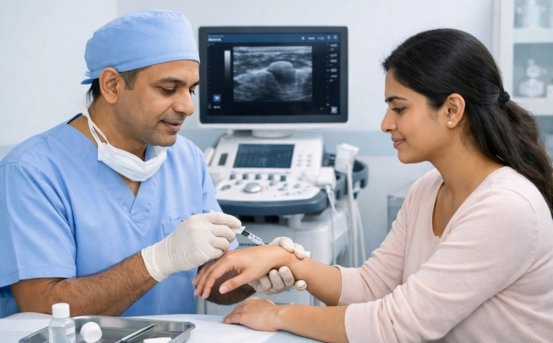
- Role of Ultrasound – Limited but Sometimes Helpful :- Ultrasound is one of the first imaging tools parents request, but in reality, its usefulness is limited. It may help locate a testis in the groin but has lower accuracy for abdominal testicles. Doctors mainly recommend ultrasound to:
- Confirm a suspected location
- Plan pre-surgical evaluation
- Rule out associated hernia or hydrocele
However, ultrasound is not a mandatory part of diagnosing orchidopexy cases.
- Hormonal Tests :- If both testicles are non-palpable, hormonal tests may be required to check whether the testes are present or have not developed at all. These include:
- hCG stimulation test – checks if testosterone levels rise
- AMH (Anti-Müllerian Hormone) test – indicates presence of testicular tissue
- LH/FSH levels
These tests help detect underlying hormonal or genetic issues and guide the treatment plan.
- MRI or CT Scan :- Advanced imaging like MRI or CT is rarely recommended because:
- They are costly
- They may require sedation for young children
- Accuracy is not significantly higher than physical exam or ultrasound
Doctors may use MRI only when testicles are suspected to be intra-abdominal but not clearly visible on other scans.
- Diagnostic Laparoscopy :- When the testicle is not found through physical examination or ultrasound, diagnostic laparoscopy becomes essential. It is a minimally invasive procedure that allows the surgeon to:
- Visualize the inside of the abdomen
- Locate the exact position of the testis
- Check the spermatic cord and blood supply
- Decide whether orchidopexy or removal (orchiectomy) is needed
If the testis is found, the surgeon can perform orchidopexy in the same sitting.
Why Early Diagnosis of Orchidopexy Is Important
Detecting an undescended testis early allows parents to take action at the right time. Here’s why timely diagnosis matters:
- Protects Fertility :- Keeping the testis inside the abdomen exposes it to higher temperature, damaging developing sperm cells. Early surgery ensures better fertility in adulthood.
- Reduces Risk of Testicular Cancer :- Untreated undescended testes have a higher cancer risk. Bringing the testicle into the scrotum allows easier monitoring and reduces long-term complications.
- Prevents Testicular Damage :- The longer a testis remains undescended, the higher the chances of reduced size or atrophy. Early diagnosis prevents permanent damage.
- Corrects Associated Conditions :- Some children have hernias, hydrocele, or abnormal testicular development. Early assessment helps in treating these conditions simultaneously.
- Improves Psychological and Physical Health :- Proper testicular placement supports normal development during puberty and boosts confidence as the child grows.
When Do Doctors Recommend Orchidopexy After Diagnosis?
Once diagnosis is confirmed, pediatric surgeons typically suggest:
- Observation until 6 months of age
- Surgery between 6–18 months
Delaying beyond 2 years is not recommended because it impacts future sperm development and increases health risks.
Preparing for Surgery After Diagnosis
Once the diagnosis is clear, doctors guide parents through:
- Pre-Surgery Evaluation
- Physical exam
- Blood tests (if needed)
- Imaging reports
- General health assessment
- Understanding the Procedure
Orchidopexy is performed under general anesthesia. The surgeon brings the testis into the scrotum and stitches it in place.
- Recovery Expectations
- Most children go home the same day
- Full recovery within 1–2 weeks
- Follow-up visits are important
The process is safe, and complications are rare when performed by experienced pediatric surgeons.
Conclusion
The diagnosis of orchidopexy surgery is a structured process that starts with a careful physical examination and may include imaging, hormonal tests, and diagnostic laparoscopy when needed. Early diagnosis ensures timely treatment, prevents long-term complications, and promotes healthy testicular development.