Introduction
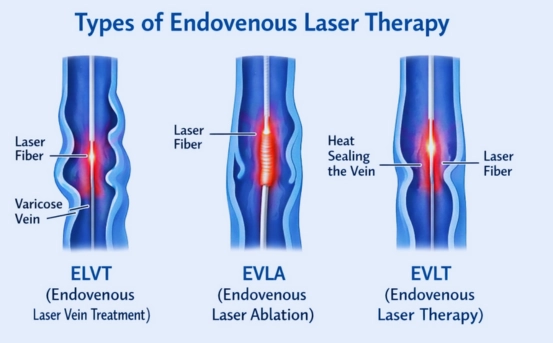
Endovenous Laser Therapy (EVLT), also known as Endovenous Laser Ablation (EVLA), is a modern, minimally invasive treatment used primarily for varicose veins and chronic venous insufficiency. Over the years, it has largely replaced traditional vein-stripping surgery due to its high success rate, reduced pain, faster recovery, and minimal scarring. The procedure works by using laser energy to close off damaged veins, redirecting blood flow to healthier veins and relieving symptoms such as swelling, pain, heaviness, and visible bulging veins.
Advancements in laser technology have led to the development of different types of Endovenous Laser Therapy, each designed to improve safety, effectiveness, and patient comfort. Understanding these types helps patients make informed decisions and allows doctors to choose the most suitable approach based on vein size, location, and severity of the condition.
Understanding Endovenous Laser Therapy
Endovenous Laser Therapy involves inserting a thin laser fiber into the affected vein under ultrasound guidance. Once positioned correctly, laser energy is delivered along the length of the vein, generating heat that causes the vein walls to collapse and seal shut. Over time, the treated vein is absorbed by the body, and blood naturally reroutes through nearby healthy veins.
The procedure is usually performed under local anesthesia, takes less than an hour, and allows patients to return to normal activities within a day or two. The main difference between the various types of EVLT lies in the laser wavelength, fiber design, and energy delivery method.
Types of Endovenous Laser Therapy
- Low-Wavelength Endovenous Laser Therapy :- Low-wavelength EVLT uses laser wavelengths typically around 810 nm, 940 nm, or 980 nm. These earlier-generation lasers primarily target hemoglobin in the blood. When the laser energy is absorbed, it heats the blood, which then transfers heat to the vein wall, causing vein closure. This type of EVLT has proven effective and was widely used in the early stages of laser vein treatment. However, because the heat is indirectly delivered to the vein wall through blood, it may result in more post-procedure discomfort, bruising, and inflammation compared to newer technologies. Despite this, low-wavelength EVLT is still used in some cases and remains a reliable treatment option when performed by experienced specialists.
- High-Wavelength Endovenous Laser Therapy :- High-wavelength EVLT utilizes laser wavelengths such as 1320 nm, 1470 nm, or higher. These lasers are designed to target water molecules within the vein wall rather than blood. This allows for more direct and controlled heating of the vein wall, leading to more precise vein closure. High-wavelength EVLT is associated with less pain, reduced bruising, and quicker recovery, making it one of the most commonly preferred methods today. Patients often report minimal discomfort and faster return to daily activities. This type of EVLT is particularly suitable for treating larger veins such as the great saphenous vein and small saphenous vein.
- Bare-Tip Laser Fiber Therapy :- In bare-tip EVLT, the laser fiber has an exposed tip that emits energy directly forward into the vein. This was one of the earliest fiber designs used in endovenous laser therapy. The forward-emitting laser heats the blood and vein wall, causing the vein to collapse. While effective, bare-tip fibers can sometimes create uneven heat distribution, increasing the risk of vein perforation or post-treatment discomfort. Due to these limitations, bare-tip laser therapy has largely been replaced by more advanced fiber technologies but may still be used in select cases.
- Radial Fiber Endovenous Laser Therapy :- Radial fiber EVLT represents a significant advancement in vein treatment technology. Instead of emitting laser energy forward, radial fibers distribute energy uniformly in a circular pattern around the vein wall. This results in consistent heating and uniform vein closure. Radial fiber EVLT offers several advantages, including reduced pain, minimal bruising, lower risk of nerve injury, and improved cosmetic outcomes. It is especially beneficial for patients with sensitive veins or those seeking the least invasive experience possible. Due to its superior comfort and effectiveness, radial fiber EVLT is now widely regarded as the gold standard in endovenous laser treatment.
- Dual-Ring Radial Laser Therapy :- Dual-ring radial EVLT is an advanced version of radial fiber technology. It uses two concentric rings of laser emission, ensuring even greater energy distribution across the vein wall. This allows the vein to close more efficiently while minimizing thermal damage to surrounding tissues. This type of EVLT is particularly effective for larger-diameter veins and complex cases of venous insufficiency. Patients undergoing dual-ring radial therapy typically experience faster healing, fewer side effects, and excellent long-term results.
- Endovenous Laser Therapy Combined with Adjunct Procedures :– In many cases, EVLT is combined with other minimally invasive treatments such as foam sclerotherapy, ambulatory phlebectomy, or ultrasound-guided injections. While EVLT addresses the main faulty vein, adjunct procedures treat smaller branch veins or residual varicosities.
This combined approach enhances overall results, improves appearance, and reduces the likelihood of recurrence. The type of EVLT used in combination therapy depends on vein anatomy and disease severity.
Choosing the Right Type of Endovenous Laser Therapy
The choice of EVLT type depends on several factors, including:
- Size and location of the affected vein
- Severity of venous insufficiency
- Patient’s pain tolerance and recovery expectations
- Doctor’s expertise and available technology
A thorough ultrasound evaluation and consultation with a vascular specialist help determine the most appropriate laser type for optimal results.
Conclusion
Endovenous Laser Therapy has transformed the treatment of varicose veins and chronic venous insufficiency by offering a safe, effective, and minimally invasive alternative to traditional surgery. With advancements in laser wavelengths, fiber designs, and energy delivery methods, multiple types of EVLT are now available to suit different patient needs and vein conditions.
From low-wavelength systems and bare-tip fibers to advanced high-wavelength radial and dual-ring technologies, each type of Endovenous Laser Therapy plays a vital role in modern vein care. Selecting the right approach ensures better comfort, quicker recovery, long-lasting vein closure, and improved quality of life. Consulting an experienced vascular surgeon is essential to determine the most suitable EVLT type and achieve the best possible outcomes with minimal complications.