





Introduction
Early and accurate diagnosis of anal cancer plays a crucial role in improving treatment outcomes and survival rates. Anal cancer is relatively uncommon compared to other gastrointestinal cancers, but its incidence has been rising globally, especially among individuals with human papillomavirus (HPV) infection, weakened immunity, or a history of anal warts. Because symptoms can often be mistaken for benign conditions like hemorrhoids or fissures, awareness about diagnostic steps is essential. Here will analysis about the diagnosis of anal cancer and its causes .
Understanding Anal Cancer
Anal cancer develops in the tissues of the anus the opening at the end of the digestive tract through which stool leaves the body. Most anal cancers begin in the squamous cells that line the anal canal. Although rare, early detection can make a significant difference, as anal cancer is highly treatable when caught in its initial stages.
Early Warning Signs of Anal Cancer
Many people are unaware that early symptoms of anal cancer can closely resemble common anorectal issues. Recognizing these signs ensures timely diagnosis
- Rectal Bleeding: One of the most common symptoms. Even slight blood spotting should not be ignored.
- Anal Pain or Discomfort: Persistent pain, swelling, or a feeling of fullness around the anus.
- Changes in Bowel Habits: Narrow stools, constipation, or unusual bowel movements.
- Itching or Discharge: Persistent anal itching or abnormal discharge can be a sign of underlying issues.
- Lumps Around the Anus: Growths or masses felt during hygiene routines or bowel movements.
If any of these symptoms persist for more than two weeks, a medical consultation is recommended.
Risk Factors That Increase the Need for Diagnosis
Certain groups are at higher risk and should be particularly vigilant about screenings and symptoms
- HPV Infection: The most significant risk factor.
- History of Anal Warts
- Smoking
- Weakened Immune System: Including individuals with HIV.
- Age Above 50
- Receptive Anal Intercourse
- Chronic Inflammation or Fistulas
Understanding one’s risk level helps prioritize timely evaluation.
How Anal Cancer Is Diagnosed
Diagnosing anal cancer involves a combination of physical examinations, imaging tests, and biopsy procedures. Here is a step-by-step look at the diagnostic process
- Medical History and Physical Examination :- The diagnosis begins with a detailed discussion about symptoms, risk factors, and any previous medical issues. Your doctor will ask about
- Duration and nature of symptoms
- History of HPV, HIV, or other infections
- Lifestyle habits
- Any changes in bowel patterns
This is followed by a Digital Rectal Examination (DRE), where the doctor gently inserts a gloved, lubricated finger into the anus to feel for abnormalities such as lumps or tenderness.
- Anoscopy :- If something unusual is detected during the DRE, the next step is anoscopy, a simple procedure that uses a small, tube-like instrument to inspect the anal canal closely. It provides better visibility of the anal lining and helps detect suspicious lesions, swelling, or sores.
- High-Resolution Anoscopy (HRA) :- HRA is a more detailed test often used in individuals with high-risk factors such as HIV. It allows magnified visualization of the anal canal, enabling detection of precancerous changes (anal intraepithelial neoplasia).
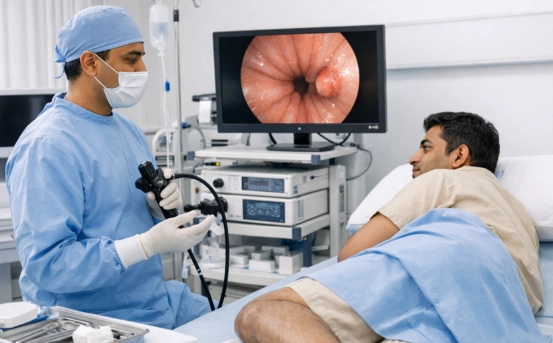
- Proctoscopy and Sigmoidoscopy :- Sometimes, doctors need to view the lower part of the rectum or colon for a clearer picture. Procedures such as proctoscopy or flexible sigmoidoscopy may be recommended, especially if symptoms extend beyond the anus or if deeper investigation is required.
- Biopsy: The Most Crucial Step :- A biopsy is the gold standard for diagnosing anal cancer. During this procedure, a small tissue sample is taken from the suspicious area identified during anoscopy or endoscopy. The sample is sent to a pathology lab to check for cancerous cells.
A biopsy confirms
- Type of cancer
- Grade
- Whether the cells are precancerous or malignant
No diagnosis is considered final without a biopsy.
Imaging Tests for Staging Anal Cancer
Once cancer is confirmed, imaging tests help determine the stage how far the disease has spread. Staging is essential for planning treatment.
- MRI Scan :- MRI provides detailed images of soft tissues in and around the anus. It helps assess tumor size, depth, and involvement of surrounding organs.
- CT Scan :- A CT scan of the abdomen and pelvis helps detect whether cancer has spread to lymph nodes or distant organs.
- PET Scan :- PET scans identify active cancer cells throughout the body. They are especially useful when doctors suspect metastasis.
- Ultrasound :- Endoanal or endorectal ultrasound may be used to evaluate the depth of tumor invasion into anal tissues.
Importance of Early Diagnosis
The key to improving survival rates in anal cancer lies in early detection. When diagnosed at Stage I or II
- Treatment success rates exceed 80–90%
- Less aggressive treatment may be required
- Chances of preserving normal bowel function improve significantly
Delaying diagnosis often leads to cancer spreading to nearby lymph nodes, making treatment more complex.
When Should You See a Doctor?
Seek prompt medical evaluation if you experience
- Persistent anal bleeding
- Changes in bowel habits
- Anal swelling or lumps
- Continuous pain or itching
- Unexplained weight loss
High-risk individuals should undergo regular screenings as recommended by healthcare providers.
Conclusion
The diagnosis of anal cancer is a structured and highly accurate process involving physical exams, endoscopic evaluations, imaging scans, and biopsy confirmation. Recognizing early symptoms and consulting a specialist promptly can dramatically improve treatment outcomes. If you or a loved one experiences persistent anal discomfort, bleeding, or unexplained changes in bowel habits, do not ignore the signs early diagnosis is the most powerful tool in fighting anal cancer.



