Introduction
Cervical cancer remains one of the most common cancers affecting women worldwide. Early diagnosis is crucial, as it significantly increases the chances of successful treatment and survival. Understanding the process of cervical cancer diagnosis, including the available tests and procedures, empowers women to take charge of their health and seek timely medical care.
Understanding Cervical Cancer
Cervical cancer originates in the cells lining the cervix, which is the lower part of the uterus connecting to the vagina. Most cases develop slowly over time, often beginning with precancerous changes known as cervical dysplasia. Human papillomavirus (HPV) infection is the primary cause of these changes. Regular screening can detect abnormal cell changes early, even before cancer develops, highlighting the importance of routine checkups.
Importance of Early Diagnosis
Early diagnosis of cervical cancer is lifesaving. When detected at an initial stage, the disease can be treated effectively with minimal invasive procedures. Advancedstage cervical cancer may require extensive surgery, chemotherapy, or radiotherapy, with a comparatively lower success rate. Hence, women are encouraged to undergo regular screening, especially if they are at higher risk due to HPV infection, smoking, or a family history of cervical cancer.
Common Screening Tests for Cervical Cancer
Screening is the first step in detecting cervical cancer or precancerous changes. The most widely recommended screening tests include
- Pap Smear (Pap Test) : The Pap smear is a simple, painless test that examines the cells from the cervix under a microscope. It helps detect abnormal or precancerous cells early. During the test, a healthcare provider collects cells from the cervix using a soft brush or spatula. Women aged 21–65 are generally advised to have a Pap smear every three years.
- HPV DNA Test : The HPV DNA test checks for the presence of highrisk HPV strains responsible for most cervical cancers. This test can be done alone or in combination with a Pap smear (cotesting) for more accurate results. The HPV test is particularly recommended for women over 30 years of age.
- Visual Inspection with Acetic Acid (VIA) : In some lowresource settings, VIA is used as a screening tool. A healthcare provider applies a dilute acetic acid solution to the cervix. Abnormal areas temporarily turn white and can be further evaluated for precancerous changes. While not as precise as Pap smear or HPV testing, VIA provides an immediate assessment.
Diagnosis of Cervical Cancer
If screening tests indicate abnormal or precancerous cells, further diagnostic procedures are necessary to confirm cervical cancer and determine its stage. These include
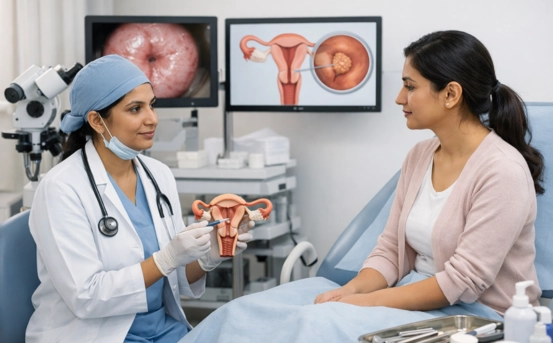
- Colposcopy : A colposcopy is a detailed examination of the cervix using a special magnifying instrument called a colposcope. This procedure helps identify abnormal areas that may require a biopsy. During the colposcopy, a solution may be applied to the cervix to highlight abnormal tissue.
- Cervical Biopsy : A biopsy involves removing a small tissue sample from the cervix for laboratory analysis. Types of cervical biopsies include
- Punch biopsy: Small sample taken from the surface of the cervix.
- Endocervical curettage: Sample taken from the cervical canal.
- Cone biopsy (conization): Larger, coneshaped section removed if abnormal cells are extensive.
A biopsy is the definitive test for confirming cervical cancer.
- Imaging Tests : Once cervical cancer is confirmed, imaging tests may be performed to determine the extent of cancer spread. These include
- MRI (Magnetic Resonance Imaging): Provides detailed images of soft tissues.
- CT Scan (Computed Tomography): Helps evaluate the size and spread of tumors.
- PET Scan (Positron Emission Tomography): Detects cancerous activity in the body.
These imaging tests help doctors stage cervical cancer accurately, guiding treatment decisions.
Understanding Cervical Cancer Stages
Cervical cancer staging describes how far the cancer has spread. Earlystage cancer is confined to the cervix, while advanced stages involve surrounding tissues, lymph nodes, or distant organs. Accurate staging is critical for choosing the most effective treatment, which may include surgery, radiotherapy, chemotherapy, or a combination of these approaches.
Risk Factors and Warning Signs
While screening is essential, awareness of risk factors and early symptoms is equally important
- Persistent HPV infection
- Smoking
- Weakened immune system
- Multiple sexual partners
- Early sexual activity
Common warning signs include abnormal vaginal bleeding, pelvic pain, or unusual discharge. Experiencing any of these symptoms warrants immediate consultation with a healthcare provider.
Prevention and Regular Screening
Prevention plays a significant role in reducing cervical cancer risk. The HPV vaccine protects against the most common cancercausing HPV strains and is recommended for girls and boys before sexual activity begins. Combined with regular screening, vaccination significantly reduces the risk of cervical cancer.
Women are encouraged to maintain routine checkups, especially after age 21, and adhere to the recommended screening intervals. Early detection not only saves lives but also allows for less invasive treatment options and better overall outcomes.
Conclusion
The diagnosis of cervical cancer involves a combination of screening tests, diagnostic procedures, and imaging studies. Timely detection through Pap smears, HPV tests, colposcopy, and biopsies plays a vital role in reducing cervical cancerrelated mortality. Awareness of risk factors, symptoms, and regular medical checkups ensures that cervical cancer can be detected at an early, treatable stage.