Introduction
Endocrine disorders are medical conditions that occur due to the malfunctioning of the endocrine glands, which are responsible for producing hormones essential for regulating various bodily functions. These disorders can significantly impact metabolism, growth, reproduction, and mood. Timely and accurate diagnosis of endocrine disorders is crucial for effective treatment and improved quality of life.
Understanding Endocrine Disorders
The endocrine system consists of glands such as the thyroid, pituitary, adrenal glands, pancreas, and gonads (ovaries and testes). Hormones secreted by these glands act as chemical messengers, regulating processes like metabolism, blood sugar levels, growth, and stress response. When hormone production is excessive or insufficient, endocrine disorders arise. Common endocrine disorders include:
- Diabetes mellitus imbalance of insulin production
- Hypothyroidism and hyperthyroidism underactive or overactive thyroid
- Cushing’s syndrome excess cortisol production
- Addison’s disease adrenal insufficiency
- Polycystic ovary syndrome (PCOS) hormonal imbalance affecting reproduction
- Growth hormone deficiencies
Early detection and proper diagnosis are critical, as untreated endocrine disorders can lead to severe complications such as cardiovascular disease, infertility, bone disorders, and metabolic imbalances.
Common Symptoms of Endocrine Disorders
The symptoms of endocrine disorders can be subtle or severe, often varying depending on the specific gland involved. Some common signs include
- Unexplained weight gain or loss
- Fatigue or persistent weakness
- Mood swings, anxiety, or depression
- Excessive thirst or frequent urination
- Changes in skin, hair, or nails
- Irregular menstrual cycles or infertility
- High blood pressure or abnormal heart rate
Because these symptoms are sometimes nonspecific, a detailed medical evaluation is necessary to determine the underlying cause.
Diagnosis of Endocrine Disorders
The diagnosis of endocrine disorders involves a combination of clinical assessment, laboratory tests, and imaging studies. The process can be divided into several steps
- Medical History and Physical Examination :- A thorough medical history provides crucial clues about potential endocrine dysfunction. Physicians ask questions regarding:
- Family history of endocrine disorders
- Onset and duration of symptoms
- Medication usage
- Lifestyle factors, including diet and exercise
- Menstrual or reproductive history in women
The physical examination may reveal signs such as
- Goiter or thyroid enlargement
- Abnormal fat distribution (e.g., in Cushing’s syndrome)
- Skin changes like hyperpigmentation
- Signs of hormone deficiencies affecting growth and development
- Laboratory Investigations :- Laboratory tests are the cornerstone of diagnosing endocrine disorders. Common tests include
- Blood tests measure hormone levels such as thyroid hormones (T3, T4, TSH), cortisol, insulin, growth hormone, and sex hormones.
- Urine tests detect hormone metabolites or glucose levels (important for diabetes and adrenal disorders).
- Stimulation or suppression tests assess gland responsiveness, for example, the dexamethasone suppression test for Cushing’s syndrome.
These tests help confirm whether a hormone is overproduced or underproduced and assist in pinpointing the affected gland.
- Imaging Studies :- Imaging techniques are often used to locate structural abnormalities in endocrine glands. Common imaging studies include:
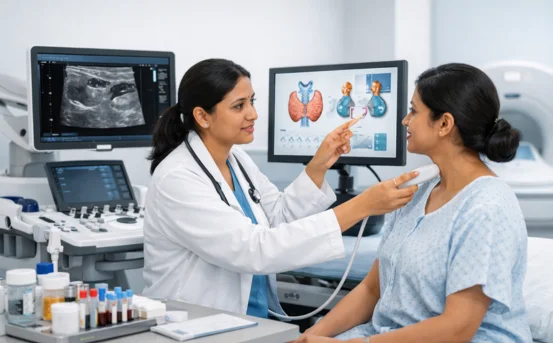
- Ultrasound commonly used for thyroid or adrenal gland evaluation
- CT scans provide detailed images of adrenal glands, pancreas, or pituitary
- MRI ideal for visualizing pituitary tumors
- Nuclear medicine scans assess gland activity using radioactive tracers
Combining laboratory results with imaging findings allows physicians to accurately identify the cause of hormonal imbalance.
- Genetic and Molecular Testing :- Some endocrine disorders have a genetic basis, such as congenital adrenal hyperplasia or familial thyroid disorders. Genetic testing can:
- Confirm hereditary conditions
- Predict disease risk in family members
- Guide personalized treatment plans
- Specialized Endocrine Tests :- Advanced diagnostics may include
- Bone density tests for osteoporosis related to hormonal deficiencies
- Oral glucose tolerance tests for diagnosing diabetes
- 24-hour urine cortisol tests for detecting abnormal cortisol production
- ACTH stimulation tests for adrenal insufficiency evaluation
These tests provide detailed insights into how well the endocrine glands are functioning.
Challenges in Diagnosing Endocrine Disorders
Diagnosing endocrine disorders can be challenging because
- Symptoms often overlap with other medical conditions
- Hormone levels fluctuate throughout the day
- Some disorders develop gradually, making early detection difficult
- Rare endocrine tumors may be overlooked
For these reasons, endocrinologists often rely on a multi-modal approach, combining clinical findings, lab tests, imaging, and patient history for an accurate diagnosis.
Importance of Early Diagnosis
Early diagnosis of endocrine disorders is essential for preventing complications. For instance
- Uncontrolled diabetes can lead to kidney failure, neuropathy, and vision problems
- Untreated hypothyroidism can cause growth delays and cognitive issues
- Excess cortisol in Cushing’s syndrome increases cardiovascular risks
Timely intervention not only improves symptoms but also enhances long-term health outcomes.
Modern Innovations in Diagnosis
The field of endocrinology has seen significant technological advancements that improve diagnostic accuracy
- Automated hormone assays provide faster and more precise hormone measurements
- High-resolution imaging detects small tumors or nodules that were previously missed
- Genomic profiling identifies mutations associated with endocrine disorders
- Wearable devices monitor glucose and other metabolic parameters continuously
These innovations are making diagnosis more efficient, less invasive, and more personalized.
Conclusion
The diagnosis of endocrine disorders is a complex but crucial process that involves a combination of clinical evaluation, laboratory testing, imaging, and sometimes genetic analysis. Early and accurate diagnosis is the key to effective treatment and preventing long-term complications. If you notice symptoms such as unexplained weight changes, fatigue, mood swings, or hormonal imbalances, consulting an endocrinologist is highly recommended.
With advancements in diagnostic tools and personalized medicine, detecting endocrine disorders has become more precise than ever before. Prioritizing timely diagnosis ensures better management, improved quality of life, and long-term health outcomes.