Introduction
Stomach cancer, also known as gastric cancer, often develops slowly over many years. In its early stages, the symptoms can be vague making timely diagnosis essential for better treatment outcomes. Understanding how stomach cancer is diagnosed helps patients know what to expect and encourages early medical consultation when symptoms appear. This comprehensive, SEO-friendly guide explains the full diagnostic process for stomach cancer, including signs, tests, procedures, staging, and when to seek medical help.
Understanding Stomach Cancer
Stomach cancer begins when abnormal cells grow uncontrollably in the lining of the stomach. The most common type is adenocarcinoma, which develops in the inner lining. Other, less common types include lymphoma, gastrointestinal stromal tumors (GISTs), and neuroendocrine tumors.
Early diagnosis significantly improves survival rates, which is why knowing the right tests and steps is crucial.
Common Symptoms That Lead to Diagnosis
Many early symptoms mimic common digestive issues, which is why stomach cancer is often diagnosed at later stages. Patients typically seek evaluation when they experience
- Persistent indigestion, heartburn, or stomach discomfort
- Feeling full after small meals
- Nausea or vomiting
- Unexplained weight loss
- Loss of appetite
- Blood in stool or black, tarry stools
- Fatigue due to anemia
- Persistent bloating or abdominal pain
If these symptoms last more than 2–3 weeks, doctors often recommend diagnostic tests.
Step-by-Step Diagnosis of Stomach Cancer
The diagnostic process involves a combination of physical examination, blood tests, imaging, endoscopy, and biopsy. Below is a detailed breakdown.
- Medical History and Physical Examination :- The diagnostic journey usually begins with
- Discussion of symptoms and their duration
- Review of medical history
- Assessment of family history of stomach or gastrointestinal cancers
- Physical examination of the abdomen for tenderness or mass
Doctors may also evaluate for signs of anemia or nutritional deficiencies.
- Blood Tests :- Although blood tests cannot confirm stomach cancer, they help indicate underlying abnormalities that warrant further investigation.
Common blood tests include
- Complete Blood Count (CBC) :- Checks for anemia, often due to slow internal bleeding from stomach tumors.
- Liver Function Tests :- Useful if doctors suspect cancer may have spread to the liver.
- Tumor Marker Tests
Markers like CEA and CA 19-9 may be elevated in some patients, but they are not definitive diagnostic tools. They are mainly used to monitor treatment progress.
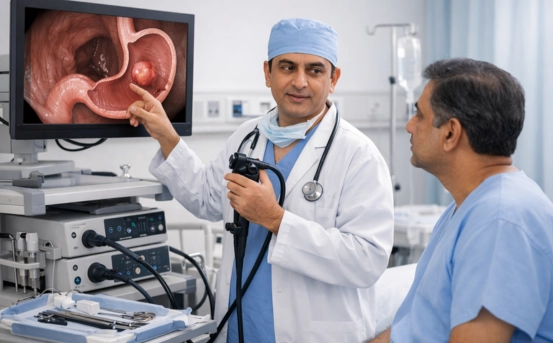
- Upper Endoscopy (Gastroscopy): The Key Diagnostic Tool :- An upper endoscopy, also called esophagogastroduodenoscopy (EGD), is the most accurate test to diagnose stomach cancer.
How It Works :- A thin, flexible tube with a camera is passed through the throat into the stomach. This allows doctors to
- Visualize the stomach lining
- Detect abnormal growths, ulcers, or inflammation
- Collect tissue samples (biopsies) for laboratory testing
Why It’s Crucial :- Biopsy results obtained during endoscopy confirm whether cancer cells are present, making this the gold standard for diagnosis.
- Biopsy and Histopathological Examination :- During endoscopy, targeted tissue samples are taken. These samples are examined under a microscope by a pathologist.
What Biopsy Confirms
- Type of cancer (adenocarcinoma, lymphoma, GIST)
- Grade of tumor (how aggressive it is)
- Presence of Helicobacter pylori infection
In some cases, advanced techniques such as immunohistochemistry (IHC) are used for detailed analysis.
- Imaging Tests for Staging and Detailed Diagnosis :- Once cancer is confirmed, imaging tests help determine its stage and whether it has spread.
- CT Scan (Computed Tomography) :- Shows detailed images of the stomach, lymph nodes, liver, pancreas, and other organs.
- PET Scan (Positron Emission Tomography) :- Helps detect metastasis by highlighting areas with high cancer activity.
- Endoscopic Ultrasound (EUS) :- Combines endoscopy and ultrasound to determine how deep the tumor has grown into the stomach walls and nearby lymph nodes.
- MRI Scan :- Useful for evaluating soft tissues and involvement of nearby organs.
- Barium Swallow X-ray (Upper GI Series) :- A contrast dye is swallowed, allowing the doctor to observe abnormalities in the stomach lining.
- Laparoscopy for Advanced Evaluation :- In some cases, minimally invasive diagnostic laparoscopy is performed
- Small incisions are made in the abdomen
- A tiny camera is inserted to check for tumor spread
- Helps plan surgery or chemotherapy
Laparoscopy is especially helpful for detecting metastasis not visible on imaging.
- Staging of Stomach Cancer :- Accurate staging helps determine the most effective treatment plan.
- Stage 0 :- Abnormal cells limited to the inner lining.
- Stage I :- Cancer is present in the stomach lining and may involve nearby lymph nodes.
- Stage II :- Cancer spreads deeper into the stomach layers and additional lymph nodes.
- Stage III :- Cancer has invaded outer layers of the stomach and more lymph nodes.
- Stage IV :- Cancer has spread to distant organs such as the liver, lungs, or bones.
Risk Factors Considered During Diagnosis
Doctors may also evaluate risk factors, including
- Chronic H. pylori infection
- Smoking or excessive alcohol consumption
- Diet high in salted, smoked, or pickled foods
- Family history of gastric cancer
- Previous stomach surgery
- Pernicious anemia
- Certain genetic syndromes
These factors help guide screening and surveillance plans.
When to See a Doctor
You should seek immediate medical evaluation if you experience
- Persistent stomach pain
- Difficulty swallowing
- Unexplained weight loss
- Continuous vomiting
- Blood in stool or vomit
- Early satiety (feeling full quickly)
Timely diagnosis can make a significant difference in treatment success.
Importance of Early Detection
Early detection improves survival rates significantly. When diagnosed early
- Treatment options are more effective
- Surgery may be curative
- Survival rates are higher
- Quality of life improves
People with strong risk factors or chronic gastric issues should undergo periodic endoscopic screening.
Conclusion
The diagnosis of stomach cancer involves a structured combination of physical exams, blood tests, endoscopy, biopsy, and advanced imaging. Because early-stage stomach cancer often presents with subtle symptoms, awareness and timely evaluation are essential. If you are experiencing persistent digestive symptoms, consulting a gastroenterologist for diagnostic testing can lead to early detection and more successful treatment outcomes.