Introduction
Angioplasty is a minimally invasive medical procedure designed to open narrowed or blocked blood vessels and restore healthy blood flow to vital organs. It is most commonly used to treat cardiovascular conditions caused by atherosclerosis, where plaque buildup restricts blood circulation. Depending on the location of the blockage, the severity of the disease, and the patient’s overall health, different types of angioplasty are performed. Each type targets specific arteries and serves a unique purpose in improving circulation, reducing symptoms, and preventing life-threatening complications. Understanding the different types of angioplasty helps patients make informed decisions about their treatment and appreciate how this advanced procedure can improve quality of life.
Types of Angioplasty
- Coronary Angioplasty :- Coronary angioplasty is the most widely performed type of angioplasty and is used to treat blockages in the coronary arteries, which supply blood to the heart muscle. When these arteries become narrowed, patients may experience chest pain, shortness of breath, or heart attacks. During coronary angioplasty, a thin catheter with a balloon at its tip is guided through a blood vessel to the blocked coronary artery. The balloon is inflated to compress the plaque against the artery wall, widening the vessel and restoring blood flow. In most cases, a stent is placed to keep the artery open permanently. This type of angioplasty is often performed as an emergency procedure during a heart attack or as a planned intervention for chronic coronary artery disease. Coronary angioplasty significantly reduces symptoms, improves heart function, and lowers the risk of future cardiac events.
- Peripheral Angioplasty :- Peripheral angioplasty is used to treat narrowed or blocked arteries outside the heart, commonly in the legs, arms, kidneys, or pelvis. Peripheral artery disease (PAD) occurs when plaque buildup limits blood flow to the limbs, causing pain, numbness, cramping, or difficulty walking. In this procedure, a catheter is inserted through a small incision and guided to the affected peripheral artery. The balloon is inflated to widen the artery, and a stent may be placed if needed. Peripheral angioplasty improves blood circulation, relieves pain, and enhances mobility, especially in patients with severe PAD. This type of angioplasty plays a crucial role in preventing complications such as non-healing wounds, infections, and limb amputation in advanced cases.
- Carotid Angioplasty :- Carotid angioplasty is performed to open narrowed carotid arteries located in the neck, which supply blood to the brain. Narrowing of these arteries increases the risk of stroke due to reduced blood flow or plaque fragments traveling to the brain. During carotid angioplasty, a balloon catheter is used to widen the narrowed artery, and a stent is placed to maintain blood flow. Special protective devices are often used during the procedure to prevent plaque debris from reaching the brain. This type of angioplasty is commonly recommended for patients who are at high risk for open carotid surgery or those with significant carotid artery narrowing detected through imaging studies.
- Renal Angioplasty :- Renal angioplasty is used to treat narrowing of the renal arteries, which supply blood to the kidneys. Renal artery stenosis can lead to uncontrolled high blood pressure and impaired kidney function. In renal angioplasty, a balloon catheter is guided to the narrowed renal artery, where it is inflated to restore normal blood flow. A stent may be placed to prevent re-narrowing. This procedure helps improve blood pressure control and preserves kidney function, especially in patients who do not respond to medications alone. Renal angioplasty is particularly beneficial for patients with resistant hypertension or declining kidney performance due to vascular disease.
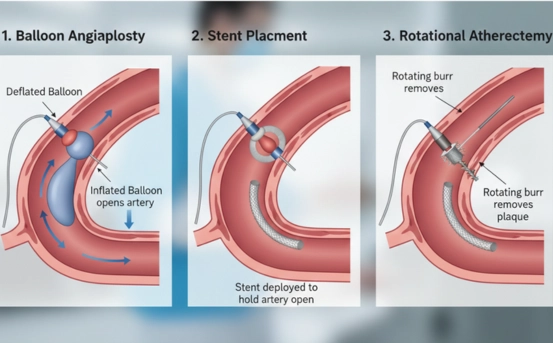
- Balloon Angioplasty :- Balloon angioplasty refers to the basic technique used in most angioplasty procedures, where a balloon-tipped catheter is inflated to widen the artery. This method may be used alone in select cases where the artery is likely to remain open without additional support.While balloon angioplasty is effective in restoring blood flow, the artery may narrow again over time. For this reason, balloon angioplasty is often combined with stent placement, especially in coronary and peripheral arteries. Despite advancements, balloon angioplasty remains a fundamental and essential component of angioplasty techniques.
- Stent Angioplasty :- Stent angioplasty involves placing a small mesh tube, known as a stent, inside the artery after balloon inflation. The stent acts as a scaffold to keep the artery open and maintain long-term blood flow. There are different types of stents used in angioplasty:
- Bare-metal stents
- Drug-eluting stents, which release medication to prevent re-narrowing
Stent angioplasty significantly reduces the risk of restenosis and has become the standard approach in most angioplasty procedures. Patients with stents require long-term medications to prevent blood clots and ensure optimal outcomes.
- Laser Angioplasty :- Laser angioplasty is a specialized technique that uses laser energy to vaporize plaque buildup within the artery. Instead of compressing plaque against the artery walls, the laser breaks it apart, allowing blood to flow freely. This type of angioplasty is typically used in complex cases where plaque is particularly hard or resistant to balloon dilation. Laser angioplasty is often combined with balloon angioplasty or stenting to achieve the best results. Although less commonly performed, laser angioplasty is a valuable option in selected patients with severe or recurrent blockages.
- Cutting Balloon Angioplasty :- Cutting balloon angioplasty uses a special balloon with tiny blades on its surface. When inflated, these blades make small incisions in the plaque, allowing the artery to expand more easily and evenly. This technique is useful in treating resistant or fibrous plaques that do not respond well to traditional balloon angioplasty. Cutting balloon angioplasty helps reduce vessel injury and improves procedural success in difficult cases.
Conclusion
Angioplasty is a versatile and highly effective procedure with several specialized types designed to treat different vascular conditions. From coronary and peripheral angioplasty to carotid, renal, laser, and stent-based techniques, each type serves a unique purpose in restoring blood flow and preventing serious complications.
The choice of angioplasty depends on the location of the blockage, severity of disease, and individual patient factors. Advances in technology and technique have made angioplasty safer, more precise, and more successful than ever before. With proper medical evaluation and post-procedure care, angioplasty offers long-lasting benefits and significantly improves patient outcomes and quality of life.