Introduction
Ganglion cysts are among the most common noncancerous lumps that develop around joints and tendons. Although harmless in most cases, they can cause discomfort, pain, or difficulty in movement depending on their size and location. Understanding the types of ganglion cysts treatment , along with their symptoms and treatment options, helps patients make informed decisions and reduce anxiety.
What Is a Ganglion Cyst?
A ganglion cyst is a fluid-filled sac that forms near joints or tendons. It contains a thick, jelly-like fluid similar to the fluid that lubricates joints (synovial fluid). These cysts can appear suddenly, grow over time, or even disappear on their own. While anyone can get a ganglion cyst, they are especially common among women, athletes, and people who perform repetitive wrist or hand motions. Ganglion cysts are noncancerous and usually harmless, but they can cause pain if they press on nearby nerves. Treatment depends on the type, location, size, and whether symptoms interfere with daily activities.
Major Types of Ganglion Cysts Treatment
Different ganglion cysts are classified based on where they develop. Each type has unique characteristics and related symptoms. Below are the most common types:
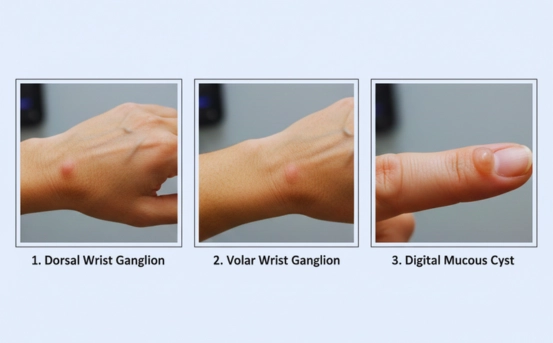
- Dorsal Wrist Ganglion Cyst :- The dorsal wrist ganglion cyst is the most common type, accounting for nearly 70% of all cases. It forms on the back (top) of the wrist, typically arising from the scapholunate joint.
Symptoms
- Noticeable lump on the back of the wrist
- Pain during wrist extension (like push-ups)
- Reduced flexibility or strength
- Discomfort when lifting weights or pushing objects
Why It Happens
Repetitive wrist movements, minor trauma, or joint irritation often lead to fluid leakage, causing cyst formation.
Treatment
Most dorsal wrist cysts do not require treatment unless painful. Options include immobilization, aspiration, and surgical removal.
- Volar Wrist Ganglion Cyst :- Volar ganglion cysts appear on the front (palm side) of the wrist, often near the radial artery. They make up around 20% of ganglion cyst cases.
Symptoms
- Round or oval lump on the palm side of the wrist
- Tingling due to pressure on nearby nerves
- Difficulty gripping objects
- Occasional pain or weakness
Why It Happens
These cysts are associated with repetitive strain, ligament tears, or inflammation in the wrist joint.
Treatment
Because they sit close to vital structures like nerves and arteries, treatment must be done carefully. Surgery is sometimes preferred over aspiration.
- Flexor Tendon Sheath Ganglion Cyst (Finger Cyst) :- Also known as a “Bible cyst,” “sesamoid cyst,” or “volar retinacular cyst,” these cysts show up near the base of the fingers along the tendon sheath.
Symptoms
- Tiny, firm pea-sized lump at the base of a finger
- Pain when gripping or applying pressure
- Clicking or locking sensation in the finger
- Sensitivity when using tools or writing
Why It Happens
Arises from trauma or repetitive finger movements causing fluid to accumulate in the tendon sheath.
Treatment
Injection therapy, aspiration, and surgical excision are effective. Surgery offers the best long-term results.
- Mucous Cyst (Digital Mucous Cyst) :- Mucous cysts form near the distal interphalangeal (DIP) joint the last joint near the fingernail. They are common in older adults, especially those with osteoarthritis.
Symptoms
- Small translucent bump near the nail
- Nail ridging or deformity
- Pain when pressing on the cyst
- Tenderness during hand use
Why It Happens
Wear-and-tear arthritis causes joint inflammation, producing excess synovial fluid that develops into a mucous cyst.
Treatment
Surgical removal is often required to prevent recurrence, as draining alone may not be effective.
- Foot or Ankle Ganglion Cyst :- These cysts develop around the top of the foot, ankle joint, or toes. They are less common compared to hand/wrist ganglions but can be quite painful.
Symptoms
- Lump on the foot or ankle
- Pain while walking or wearing shoes
- Pressure or burning sensation
- Swelling or difficulty bending the foot
Why It Happens
Caused by repetitive strain, ligament injuries, or tight footwear.
Treatment
Changes in footwear, aspiration, padding, and surgery are common management approaches.
- Knee Ganglion Cyst :- Ganglion cysts can develop around the knee joint, including the ACL, PCL, or meniscus. These cysts are deeper and sometimes detected only on MRI.
Symptoms
- Deep knee pain
- Clicking or locking of the joint
- Stiffness while bending
- Swelling (if cyst is near the surface)
Why It Happens
Often linked to sports injuries, ligament tears, or repetitive knee strain.
Treatment
Aspiration under ultrasound guidance or arthroscopic removal.
- Shoulder Ganglion Cyst :- Shoulder ganglion cysts form near the rotator cuff or labrum. They usually result from shoulder instability or tears.
Symptoms
- Weakness in lifting the arm
- Shoulder pain or stiffness
- Nerve compression causing numbness
- Reduced range of motion
Why It Happens
Leakage of joint fluid from rotator cuff or labral injuries leads to cyst formation.
Treatment
Treating the underlying tear is essential. Surgery may be needed.
Causes of Ganglion Cysts
Although the exact cause is unclear, several factors contribute:
- Joint or tendon irritation
- Repetitive motions (typing, gym workouts, sports)
- Past injuries or sprains
- Arthritis, especially in older adults
- Fluid leakage due to structural weakness
Diagnosis of Ganglion Cysts
Doctors usually diagnose ganglion cysts through:
- Physical examination
- Ultrasound – identifies fluid-filled structures
- X-ray – rules out bone issues
- MRI – used for deep or unclear cysts
Treatment Options
Ganglion cyst treatment depends on symptoms, type, size, and location.
- 1. Observation :- If painless, no treatment may be required.
- Immobilization :- Wearing a brace can reduce inflammation and cyst size.
- Aspiration :- A needle is used to remove fluid.
Pros: quick, simple
Cons: cyst may return - Surgery :- Best option for recurring or painful cysts.
Involves removing the cyst capsule and its root to reduce recurrence.
When to Seek Medical Help
Seek consultation if you experience:
- Persistent pain
- Numbness or tingling
- Rapid growth of the lump
- Difficulty moving the affected joint
- Cosmetic concerns
Early diagnosis can prevent complications like nerve compression or joint stiffness.
Conclusion
Ganglion cysts come in many types, depending on where they appear wrist, fingers, knees, shoulders, and more. Most are harmless, but some can become painful or affect movement. Understanding the types of ganglion cysts helps you identify symptoms early and seek appropriate treatment.