Introduction
Ladd’s procedure is a life-saving surgery used to correct intestinal malrotation, a congenital condition where the intestines fail to rotate normally during fetal development. This abnormal alignment can cause serious complications such as midgut volvulus, intestinal obstruction, and restricted blood flow to the intestine. Because timely treatment is essential, understanding the types of Ladd’s procedure surgery and how surgeons approach this condition can help families make informed decisions.
What Is the Ladd’s Procedure?
Before understanding the types, it’s important to know what the Ladd’s procedure involves. Regardless of the technique used, the main goals remain the same
- Correct the abnormal rotation of the intestines
- Widen the mesentery to prevent volvulus
- Divide Ladd’s bands that block the duodenum
- Place the small intestine on the right side and the large intestine on the left
- Remove the appendix to avoid future diagnostic confusion
These steps help ensure proper intestinal function and minimize the risk of future complications.
Types of Ladd’s Procedure Surgery
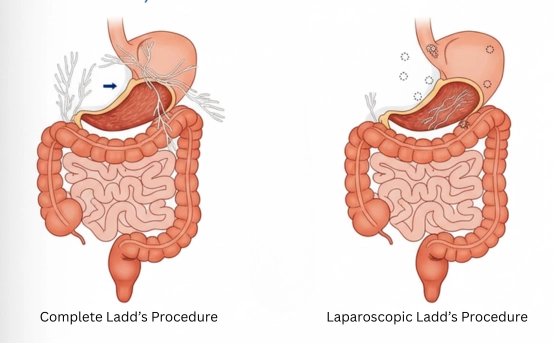
There are two main types of surgical approaches used for the Ladd’s procedure
- Open Ladd’s Procedure
- Laparoscopic Ladd’s Procedure
Both are effective and widely performed depending on the patient’s condition, age, severity of symptoms, and surgeon expertise.
- Open Ladd’s Procedure :- The open approach is the traditional and most commonly used technique, especially in emergency cases such as acute volvulus.
How It Works
- The surgeon makes a single incision in the abdomen.
- Ladd’s bands are divided to release the duodenum.
- The intestines are inspected, untwisted if volvulus is present, and placed in their proper position.
- The mesentery is widened to prevent future twisting.
- An appendectomy is performed as part of the procedure.
Advantages
- Highly effective in severe or emergency cases
- Allows direct visualization of the intestines
- Ideal for infants with compromised blood supply
Limitations
- Longer recovery time
- Larger scar
- Higher risk of postoperative adhesions
The open Ladd’s procedure remains the gold standard when the patient is critically ill or when surgeons need rapid access to the abdominal cavity.
- Laparoscopic Ladd’s Procedure :- The laparoscopic approach is a minimally invasive alternative gaining popularity, especially in stable infants, children, and adults diagnosed early.
How It Works
- Several small keyhole incisions are made
- A laparoscope (tiny camera) and instruments are inserted
- Surgeons divide Ladd’s bands, widen the mesentery, and reposition the intestines
- The appendix is removed laparoscopically
Advantages
- Smaller incisions and minimal scarring
- Faster recovery and shorter hospital stay
- Reduced postoperative pain
- Lower risk of wound complications
Limitations
- Not suitable for unstable patients or severe volvulus
- Requires specialized surgical skill and equipment
- May need to convert to open surgery if visibility is poor
Laparoscopic Ladd’s procedure is increasingly preferred for elective or stable cases due to its patient-friendly recovery profile.
Other Variations in Ladd’s Surgery Approach
While the two major methods are open and laparoscopic, several variations may be used depending on the patient’s specific condition.
- Emergency Ladd’s Procedure :- When midgut volvulus is suspected, emergency surgery is performed immediately to prevent intestinal necrosis. This may involve
- Rapid detorsion of the twisted bowel
- Assessing bowel viability
- Possible bowel resection if tissue damage is severe
- Ladd’s Procedure with Bowel Resection :- If part of the intestine has lost blood supply, surgeons may need to
- Remove the affected bowel segment
- Reconnect healthy segments through anastomosis
This is typically required in advanced volvulus cases.
- Ladd’s Procedure for Adults :- Although malrotation is usually diagnosed in infancy, some adults present later with chronic abdominal pain, bloating, or recurrent discomfort. Adult surgeries may involve
- More careful adhesiolysis
- Additional steps to correct long-standing anatomical issues
- Ladd’s Procedure with Additional Supportive Surgeries :- In complex cases, surgeons may combine Ladd’s procedure with
- Gastrostomy tube placement
- Intestinal decompression
- Adhesion prevention strategies
These are used only when medically necessary.
Recovery After Ladd’s Procedure
Recovery varies based on whether the surgery was open or laparoscopic.
Hospital Stay
- Laparoscopic: 2–4 days
- Open: 5–7 days or longer in emergency cases
Feeding & Nutrition
- Feeding usually begins once bowel function returns
- Infants and children may start with clear liquids
- Some may require temporary tube feeding in severe cases
Pain & Activity
- Pain is usually milder after laparoscopic surgery
- Normal activities resume gradually over weeks
- Parents should follow all post-surgery care instructions carefully
Long Term Outlook
Most patients recover fully and live a normal life. However, some may experience occasional digestive issues such as bloating or constipation, which typically improve with time.
Conclusion
The Ladd’s procedure is a critical treatment for intestinal malrotation, and understanding the different surgical approaches open and laparoscopic helps families feel more prepared and confident. Each technique has its benefits, and the choice depends on the patient’s condition and the surgeon’s expertise. With timely intervention and appropriate care, the prognosis after Ladd’s procedure is excellent.