Introduction
The larynx, commonly known as the voice box, is an important organ located in the throat that plays a vital role in breathing, speaking, and protecting the airway during swallowing. It contains the vocal cords, which produce sound when air passes through them. Any disease or damage to the larynx can affect voice quality, breathing, and overall communication.
Laryngeal surgery is performed to treat various conditions such as voice disorders, airway obstruction, infections, injuries, benign growths, and cancer. Depending on the severity and type of condition, different surgical approaches are used. Some procedures are minimally invasive, while others involve more extensive reconstruction. Understanding the types of laryngeal surgery helps patients feel informed and confident about their treatment.
Types of Laryngeal Surgery
- Microlaryngeal Surgery :- Microlaryngeal surgery is one of the most common and minimally invasive types of laryngeal surgery. It is mainly performed to treat voice-related disorders such as vocal cord nodules, polyps, cysts, and papillomas. In this procedure, a special microscope and fine surgical instruments are used to operate on the vocal cords with high precision. The surgery is performed through the mouth, so there are no external cuts. Microlaryngeal surgery helps preserve voice quality while removing abnormal tissue. Recovery is usually quick, but voice rest is often recommended for a few days after surgery.
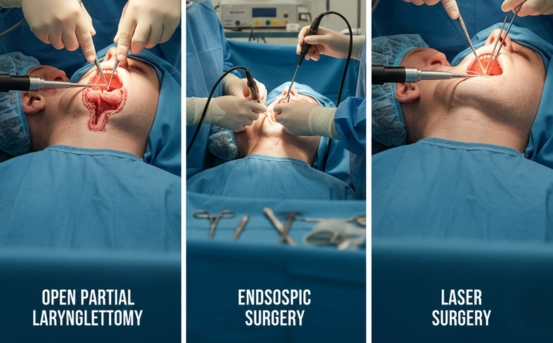
- Endoscopic Laryngeal Surgery :- Endoscopic laryngeal surgery uses a thin, flexible or rigid endoscope equipped with a camera to visualize the larynx. This technique allows surgeons to diagnose and treat various laryngeal conditions with better accuracy. Endoscopic surgery is commonly used to remove benign growths, treat airway narrowing, and manage early-stage laryngeal cancer. The procedure causes minimal tissue damage, reduces pain, and shortens recovery time. It is often performed as a day-care procedure under general anesthesia. Laser
- Laryngeal Surgery :- Laser laryngeal surgery is an advanced technique that uses focused laser energy to remove or reshape abnormal tissue in the larynx. This method provides excellent precision and minimizes bleeding. Laser surgery is widely used to treat vocal cord lesions, recurrent respiratory papillomatosis, and early-stage laryngeal cancer. It helps preserve surrounding healthy tissue and voice function. Laser laryngeal surgery is known for faster healing, reduced scarring, and improved surgical outcomes.
- Open Laryngeal Surgery :- Open laryngeal surgery is performed when minimally invasive techniques are not sufficient. This type of surgery involves making an external incision in the neck to access the larynx directly. Open surgery is usually required for large tumors, severe trauma, advanced cancer, or structural abnormalities. Although it involves a longer recovery period, it allows for complete removal of diseased tissue and reconstruction if needed. Post-surgical rehabilitation, including speech therapy, plays an important role in recovery.
- Partial Laryngectomy :- Partial laryngectomy is a surgical procedure where only a portion of the larynx is removed. It is mainly performed for selected cases of laryngeal cancer where the disease is limited. The goal of partial laryngectomy is to remove cancer while preserving as much voice and breathing function as possible. Depending on the extent of surgery, patients may need temporary breathing support or feeding assistance. With proper rehabilitation, many patients regain functional speech.
- Total Laryngectomy :- Total laryngectomy involves complete removal of the larynx and is usually recommended for advanced laryngeal cancer. After this surgery, breathing is permanently redirected through a stoma, which is an opening created in the neck. Although total laryngectomy results in loss of natural voice, patients can learn alternative methods of communication, such as esophageal speech, electrolarynx use, or tracheoesophageal voice prosthesis. This surgery is life-saving and significantly improves survival in advanced cases.
- Laryngeal Framework Surgery :- Laryngeal framework surgery focuses on modifying the cartilage framework of the larynx to improve voice quality. It is commonly used to treat vocal cord paralysis or weakness. Procedures such as thyroplasty involve repositioning or supporting the vocal cords to improve sound production. This type of surgery is often performed under local anesthesia, allowing surgeons to adjust voice quality during the procedure. Patients usually experience significant voice improvement.
- Tracheostomy-Related Laryngeal Surgery :- In some cases, laryngeal surgery involves creating or managing a tracheostomy to secure the airway. This may be temporary or permanent, depending on the underlying condition. Tracheostomy-related procedures help patients breathe safely when the larynx is obstructed or healing after major surgery. Proper care and follow-up are essential for recovery and comfort.
Conclusion
Laryngeal surgery includes a wide range of procedures designed to treat conditions affecting the voice box. From minimally invasive microlaryngeal and laser surgeries to complex open surgeries and laryngectomies, each type is tailored to the patient’s specific medical needs. The choice of laryngeal surgery depends on the underlying condition, severity, and overall health of the patient. Early diagnosis and timely treatment are crucial for preserving voice, breathing, and quality of life. Consulting an experienced ENT specialist ensures the most appropriate surgical approach and the best possible outcome.