Introduction
Orchidopexy is a surgical procedure performed to correct an undescended testicle (cryptorchidism). It is one of the most common pediatric surgeries and is usually recommended when the testicle fails to move into the scrotum naturally within the first few months of life. Early treatment is important because undescended testicles can lead to long-term issues such as infertility, testicular torsion, trauma, and increased risk of testicular cancer.
Understanding Orchidopexy Surgery
Orchidopexy aims to bring the undescended testicle into its proper position in the scrotum. Modern surgical techniques are highly safe, minimally invasive, and highly effective. The type of technique used depends on:
- The location of the testicle
- The age of the child
- Whether one or both testicles are undescended
- Associated conditions such as hernia or absent testis
Knowing the types of orchidopexy helps parents understand why doctors choose a particular method and how it benefits the child.
Types of Orchidopexy Surgery
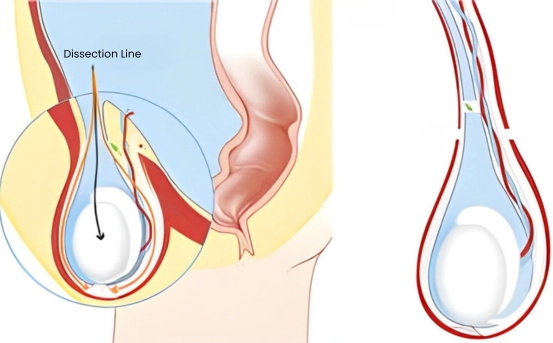
- Standard (Inguinal) Orchidopexy :- This is the most common technique used when the testicle can be felt in the groin area. The surgeon makes a small incision in the groin, brings the testicle down, and positions it securely in the scrotum.
Steps Involved
- A small incision is made in the groin fold.
- The testicle is gently mobilized and separated from surrounding tissues.
- The surgeon creates a pouch in the scrotum.
- The testicle is placed and fixed in the scrotum to prevent it from going back up.
When It Is Used
- For palpable testicles (those that can be felt)
- Children between 6 months and 2 years
Advantages
- High success rate
- Small incision and minimal scarring
- Usually done as a day-care procedure
- Laparoscopic Orchidopexy :- Laparoscopic orchidopexy is used when the testicle cannot be felt during physical examination (non-palpable testicle). It uses a thin camera and very small instruments inserted through tiny abdominal incisions.
Steps Involved
- A laparoscope is inserted through the belly button.
- The surgeon visualizes the testicle inside the abdomen.
- Depending on the distance and spermatic cord length, the testicle is brought down in one or two stages.
- The testicle is fixed in the scrotum using minimally invasive tools.
When It Is Used
- Non-palpable testicles
- Testicles located inside the abdomen
- Bilateral undescended testes
Advantages
- Minimally invasive
- Faster recovery
- Better visualization for the surgeon
- Less pain and smaller scars
- Fowler–Stephens Orchidopexy (Single & Two-Stage) :- This specialized technique is used when the testicle is located high inside the abdomen and the spermatic vessels are too short to bring it down safely.
Types:
- Single-Stage Fowler–Stephens
- The surgeon divides the spermatic vessels and brings the testicle down in a single surgery.
- Two-Stage Fowler–Stephens
- Stage 1: The blood vessels are clipped, allowing new collateral blood supply to form.
- Stage 2 (after 6 months): The testicle is mobilized and moved into the scrotum.
When It Is Used
- High abdominal testes
- Short spermatic cord
- Situations where standard orchidopexy would cause tension
Advantages
- Helps preserve blood supply
- Higher success rates in difficult cases
- Reduces testicular atrophy risk
- Peeping Testis Orchidopexy :- “Peeping testis” refers to a testicle that partially enters the inguinal canal from the abdomen but cannot fully descend. It usually becomes visible during laparoscopic examination.
Approach
- Often managed laparoscopically
- The surgeon identifies the testicle peeping from the internal ring
- The testicle is mobilized gently and brought down into the scrotum
- If vessels are short, Fowler–Stephens method may be used
When It Is Used
- Testicles that intermittently descend and ascend
- Testicles that appear during laparoscopy but not externally
Advantages
- Prevents the risk of torsion or damage
- Effectively manages borderline cases
- Orchiopexy for Retractile Testis :- A retractile testis moves back and forth between the groin and scrotum due to an overactive cremaster muscle. Many cases improve naturally, but if it becomes ascending or stays outside the scrotum, surgery is recommended.
Approach
- A simple orchidopexy is performed
- The testicle is positioned permanently in the scrotum
- The cremaster muscle may be released if overly tight
When It Is Used
- When retractile testis becomes an ascending testis
- Persistent pain or discomfort
- If testis frequently stays in the groin
Advantages
- Prevents future fertility issues
- Avoids risk of testicle ascending permanently
- Microsurgical Orchidopexy :- Microsurgical orchidopexy uses advanced surgical microscopes to improve precision and protect delicate blood vessels and nerves.
Uses
- Complex cases
- Re-do orchidopexy
- Post-trauma undescended testis
- Cases with very short spermatic cord
Advantages
- Higher accuracy
- Reduces risk of testicular atrophy
- Preserves fertility potential
- Orchiopexy with Hernia Repair :- Many children with undescended testicles also have an associated inguinal hernia. During orchidopexy, the surgeon repairs the hernia sac in the same procedure.
Approach
- Hernia sac is identified and closed
- Testicle is then brought down and fixed
- Prevents hernia complications in the future
Advantages
- Two problems treated in one surgery
- No need for separate procedures
Recovery After Orchidopexy
Most children recover quickly and can return home the same day. Key points:
- Mild swelling or discomfort for a few days
- Avoid vigorous activities for 2 weeks
- Follow-up to ensure proper testicle position
- Rare complications like infection or atrophy
Early diagnosis and timely surgery ensure the best long-term outcomes.
Conclusion
Orchidopexy is a safe and effective procedure that corrects undescended testicles and protects long-term fertility and testicular health. With several types of surgical techniques available such as standard inguinal orchidopexy, laparoscopic methods, Fowler–Stephens, and microsurgical approaches doctors can choose the best method based on the testicle’s location and condition.