Introduction
Squint, also known as strabismus, is a condition where the eyes do not align properly and point in different directions. One eye may look straight while the other may turn inward, outward, upward, or downward. Squint can occur in children as well as adults, and early treatment is crucial to prevent complications like amblyopia (lazy eye), blurred vision, or double vision. Modern ophthalmology offers several effective ways to correct squint, depending on the cause, severity, and age of the patient. From glasses and eye exercises to advanced surgical techniques, squint correction is highly individualized and aims to restore both cosmetic appearance and functional vision.
What Is Squint Correction?
Squint correction refers to various treatments used to realign the eyes so they point in the same direction. Treatment may involve
- Improving focus through glasses
- Strengthening eye muscles
- Weakening overactive muscles
- Enhancing brain–eye coordination
- Surgically adjusting the eye muscle positions
The choice of treatment depends on whether the squint is congenital, accommodative, paralytic, or due to any underlying medical condition.
Types of Squint Correction
Below are the most widely used and effective squint correction methods practiced worldwide.
- Glasses or Contact Lenses :- For many children, squint, especially accommodative esotropia is caused by uncorrected refractive errors such as hyperopia (farsightedness). In such cases, glasses alone can fully correct the squint.
How it works
- Glasses reduce the effort needed to focus.
- With less strain, the eyes align naturally.
- In some cases, bifocal lenses may be recommended to improve near focus.
Who benefits?
- Children with refractive errors
- Individuals with accommodative squint
Advantages
- Non-invasive
- Comfortable for children
- Often completely eliminates the squint
Glasses remain one of the simplest and most effective tools for early squint management.
- Eye Patching (Occlusion Therapy) :- When squint leads to amblyopia (lazy eye), patching becomes essential.
How it works
- The stronger eye is covered with a patch.
- This forces the weaker eye to work harder.
- Over time, visual acuity improves and eye alignment becomes better.
Who benefits?
- Children with amblyopia due to squint
- Patients in early stages of eye misalignment
Advantages
- Non-surgical and affordable
- Boosts the weaker eye’s vision significantly
Patching is most effective when started early, ideally before the age of seven.
- Vision Therapy & Eye Exercises :- Vision therapy, also called orthoptic exercises, strengthens the brain-eye coordination needed to maintain proper eye alignment.
How it works
- A set of exercises improve focusing ability, eye tracking, and convergence.
- Often performed under an orthoptist’s supervision.
- May be combined with glasses or patching.
Effective for
- Convergence insufficiency
- Intermittent squints
- Mild coordination-related misalignment
Benefits
- Non-invasive
- Improves binocular vision
- Helps avoid surgery in mild cases
Vision therapy is especially helpful for school-age children and office workers who experience eye fatigue.
- Prism Glasses :- Prism lenses help correct double vision (diplopia) caused by minor eye misalignment.
How they work
- The prism changes the direction of light entering the eye.
- It helps both eyes work together by reducing strain.
- Ideal for adults with small squints or sudden-onset misalignment.
Ideal for
- Paralytic squints
- Adults recovering from nerve palsies
- Patients with mild eye deviation
Prism glasses do not cure the squint but offer immediate visual comfort.
- Botulinum Toxin (Botox) Injection :- Botox is a modern, minimally invasive option for certain types of squint.
How it works
- Botox is injected into the overactive eye muscle.
- It temporarily weakens the muscle.
- This allows the opposite muscle to strengthen and restore eye alignment.
Useful for
- Paralytic squints
- Small-angle deviations
- Patients unsuitable for surgery
- Adults with new-onset squint
Benefits
- Quick and painless
- No incision required
- Effective for temporary or adjustable correction
Botulinum toxin is increasingly used in adults and children older than one year.
- Squint Surgery (Strabismus Surgery) :- Surgery is the most definitive and widely used squint correction technique, especially when non-surgical methods are insufficient.
How it works
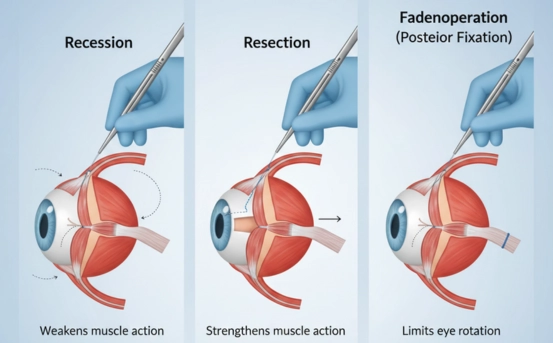
Squint surgery involves adjusting the eye muscles in one of the following ways
Recession
- The overactive muscle is moved back from its original point.
- This weakens its pulling effect.
Resection
- A weak muscle is shortened.
- This strengthens its pulling power.
Transposition Surgery
- Muscles are repositioned to compensate for paralytic or vertical squints.
Indications for surgery
- Congenital squint
- Non-accommodative squint
- Large-angle deviation
- Squint not corrected with glasses or therapy
- Cosmetic improvement for adults
Advantages
- Long-term correction
- Restores eye alignment
- Enhances depth perception
Modern squint surgery is safe, typically done under general anesthesia in children and local anesthesia in adults.
- Adjustable Suture Technique :- This is an advanced surgical method used predominantly in adults.
How it works
- Sutures on the eye muscles are left adjustable for a short time after surgery.
- Once the patient is awake, the surgeon fine-tunes the muscle position.
- This ensures precision alignment.
Best for
- Adults with unpredictable muscle response
- Complex or re-operative squints
Benefits
- Highly accurate results
- Reduced chance of re-surgery
Adjustable sutures are becoming increasingly popular due to their excellent outcomes.
How to Choose the Right Type of Squint Correction
The treatment depends on
- Age of the patient
- Type of squint (esotropia, exotropia, vertical squint)
- Severity of misalignment
- Presence of refractive error
- Is amblyopia present?
- Cause of squint (congenital, injury, nerve palsy, refractive)
An eye specialist performs a detailed evaluation, including
- Vision test
- Eye muscle examination
- Retinal check
- Binocular vision assessment
Based on this, a personalized treatment plan is designed.
Conclusion
Squint correction has advanced significantly, offering safe and effective treatment options for both children and adults. Whether through glasses, patching, eye exercises, or advanced surgical techniques, the goal is to achieve proper eye alignment, improve vision, and enhance confidence. Early diagnosis plays a key role in preventing complications like lazy eye, so seeking timely eye care is essential.