Introduction
Tubectomy is one of the most reliable and widely performed permanent birth control methods for women. Also known as female sterilization or tubal ligation, this procedure blocks, ties, or seals the fallopian tubes to prevent the egg from meeting the sperm, effectively eliminating the chances of pregnancy. Tubectomy is safe, quick, and offers long-term results, making it a preferred choice for women who have completed their families.
What Is Tubectomy?
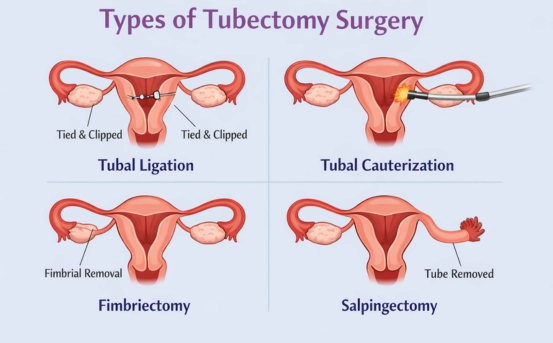
Tubectomy is a surgical sterilization procedure that permanently prevents pregnancy by interrupting the pathway of the fallopian tubes. When the tubes are closed or removed, fertilization cannot occur. The decision to undergo tubectomy is generally taken by women who do not wish to have any more children. The procedure does not affect hormones, menstrual cycles, libido, or overall health, making it a safe family planning option.
Why Are There Different Types of Tubectomy?
Not every woman is suitable for the same surgical approach. Factors such as medical history, previous surgeries, weight, delivery status, and personal preferences determine which method is ideal. Broadly, tubectomy procedures are categorized based on how the fallopian tubes are blocked and how the surgery is performed.
Major Types of Tubectomy
Below are the most commonly performed tubectomy methods used worldwide:
- Laparoscopic Tubectomy :- Laparoscopic tubectomy is the most preferred technique today due to its minimally invasive nature.
How It Works
- Two or three very small incisions are made in the abdomen.
- A laparoscope (thin tube with a camera) is inserted to visualize the tubes.
- Surgeons use instruments to clip, cut, or cauterize the fallopian tubes.
Techniques Used in Laparoscopic Tubectomy
- Tubal clipping (Filshie clips / Hulka clips)
- Tubal rings (Falope rings)
- Electrocautery (burning and sealing the tubes)
Benefits
- Minimal scarring
- Quick recovery (3–5 days)
- Short hospital stay
- Very low complication rate
Best For :- Women opting for planned sterilization unrelated to childbirth.
- Postpartum Tubectomy (After Delivery) :- This type of tubectomy is performed soon after childbirth, typically within 24–48 hours.
How It Works
- After a normal delivery, a small incision is made near the navel.
- After a C-section, tubectomy can be done immediately after delivering the baby using the same incision.
Benefits
- Convenient, as the patient is already hospitalized
- No need for a second surgery
- Highly effective
- Recovery coincides with post-delivery rest
Best For :- Women who have completed their families and prefer sterilization immediately after childbirth.
- Mini-Laparotomy (Mini-Lap) Tubectomy :- Mini-laparotomy is a small-incision abdominal surgery often used in mass sterilization programs.
How It Works
- A small incision (2–5 cm) is made above the pubic hairline.
- The fallopian tubes are brought to the surface and tied, cut, or sealed.
Benefits
- Simple and cost-effective
- No need for advanced laparoscopic equipment
- Safe for women who recently delivered or who cannot undergo laparoscopy
Best For :- Women seeking permanent contraception after childbirth or in locations where advanced surgical tools are unavailable.
- Open Tubectomy (Laparotomy) :- This is a traditional method, performed through a larger abdominal incision.
How It Works
- A 6–10 cm incision is made in the lower abdomen.
- The surgeon accesses and blocks the fallopian tubes manually.
Benefits
- Suitable for women with complex medical conditions
- Ideal for those who may need combined abdominal procedures
Drawbacks
- Longer hospital stay
- Noticeable scarring
- Slower recovery
Best For :- Women undergoing abdominal surgery for other conditions or those not suited for minimally invasive techniques.
- Partial Salpingectomy :- Partial salpingectomy involves removing a small section of each fallopian tube.
How It Works
- A portion of the tube is cut and removed.
- The remaining ends are tied or sealed.
Benefits
- Highly effective with near-zero failure rate
- Commonly performed postpartum
Best For :- Women wanting a robust, long-lasting method after delivery.
- Total Salpingectomy (Complete Tubal Removal) :- Total salpingectomy has gained popularity because it offers added protection against ovarian cancer.
How It Works
- The entire fallopian tube is surgically removed.
Benefits
- Absolutely permanent contraception
- Reduces ovarian cancer risk
- No chance of tubal failure or ectopic pregnancy
Best For :- Women who want a definitive permanent solution and may benefit from reduced cancer risk.
How to Choose the Right Type of Tubectomy
Choosing a suitable method depends on multiple factors
- Health condition :- Your medical history and any existing conditions play a major role.
- Timing :- Whether the procedure is being done postpartum, during another surgery, or as a standalone procedure.
- Recovery preference :- Minimally invasive methods offer faster healing.
- Availability of equipment :- Certain techniques require specialized laparoscopic tools.
- Doctor’s recommendation :- A gynecologist will help determine the safest and most effective method.
Safety, Risks, and Considerations
Tubectomy is a highly safe procedure, but like all surgeries, it carries some risks
- Mild abdominal pain or discomfort
- Infection at the incision site
- Rare bleeding
- Failure rate (very low, around 0.5%)
- Rare risk of ectopic pregnancy if failure occurs
Most women resume normal activities within a week.
Recovery After Tubectomy
Recovery depends on the procedure type but usually includes
- Rest for a few days
- Avoiding heavy lifting for a week
- Keeping the incision area clean
- Taking prescribed medications
Women can return to normal routines quickly, especially after laparoscopic tubectomy.
Conclusion
Tubectomy is a safe, permanent, and highly effective birth control option for women who have decided not to have more children. With various methods available from laparoscopic to postpartum and salpingectomy women can choose a procedure that best fits their health needs and lifestyle.