Introduction
Chemotherapy is one of the most effective treatments for many types of cancer. But to deliver these powerful medications safely and consistently, doctors often use special devices known as vascular access devices (VADs). These devices allow medications to enter the bloodstream directly, reduce repeated needle pricks, and ensure comfort throughout the treatment journey. Understanding the different types of vascular access for chemotherapy can help patients and caregivers make informed decisions about the safest and most convenient option.
What Is Vascular Access for Chemotherapy?
Vascular access refers to the method used to deliver chemotherapy drugs into the bloodstream. Since these medications can be strong and sometimes irritate smaller veins, doctors often place special devices in larger veins to ensure safe and steady drug delivery.
These devices are designed to:
- Provide long-term access without repeated needle insertions
- Reduce the risk of vein damage
- Make blood test sample collection easier
- Improve the overall treatment experience
The type of vascular access chosen depends on treatment duration, patient comfort, overall health, and the specific chemotherapy regimen.
Major Types of Vascular Access for Chemotherapy
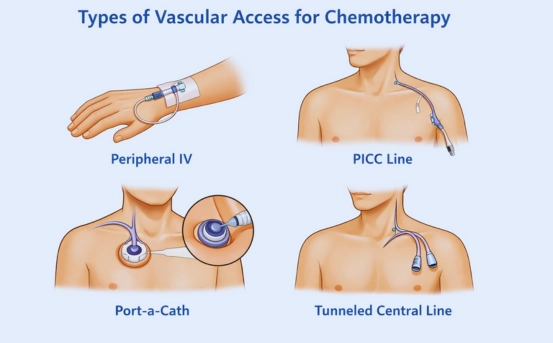
Chemotherapy access devices fall into three major categories:
- Peripheral IV Catheters
- Central Venous Catheters (CVCs)
- Implanted Ports (Port-a-Cath)
Each type has its own function, benefits, and suitability based on patient needs.
- Peripheral IV Catheter (Short IV Line) :- A Peripheral Intravenous (IV) catheter is the simplest and most commonly used short-term vascular access method. It is placed into a small vein in the hand or arm.
How It Works
- Inserted in a small vein near the skin surface
- Used for short treatment sessions
- Removed after each chemotherapy cycle or within a few days
Advantages
- Quick and easy to place
- No surgery required
- Minimal maintenance
Limitations
- Not suitable for strong or irritant chemotherapy drugs
- Needs frequent replacement (every few days)
- Can cause vein irritation or swelling
- Not ideal for long-term treatment
Ideal For
Patients receiving short-duration chemotherapy, hydration, antibiotics, or supportive care injections.
- Central Venous Catheters (CVCs) :- Central Venous Catheters are long, flexible tubes placed in large veins — usually the chest or neck. They are ideal for patients requiring long-term chemotherapy or complex treatment plans.
Types of CVCs include:
- PICC Lines
- Tunneled Catheters (e.g., Hickman®)
- Non-tunneled CVCs
- PICC Line (Peripherally Inserted Central Catheter) :- A PICC line is a long catheter inserted through a vein in the upper arm and advanced into a large central vein near the heart.
How It Works
- Inserted under local anaesthesia
- Can stay in place for weeks to months
- Used for chemotherapy, nutrition, and blood draws
Advantages
- No surgical procedure needed
- Lower risk of complications than chest catheters
- Suitable for medium to long-term treatment
Limitations
- Requires strict cleaning and flushing
- Cannot be used for activities like swimming
- Risk of clotting or infection
- Visible externally
Ideal For
Patients needing long-term but non-permanent chemotherapy access.
- Tunneled Central Catheters (Hickman, Broviac) :- These catheters are inserted into a central vein through the chest and tunneled under the skin to reduce infection risk.
How It Works
- Inserted surgically under local or general anaesthesia
- Designed for long-term or continuous chemotherapy
- External part allows easy access for drugs or blood draws
Advantages
- Durable for long-term treatment
- Lower infection risk due to subcutaneous tunnel
- Suitable for high-dose or frequent chemotherapy
Limitations
- Requires daily cleaning and dressing
- Visible outside the body
- Restricts some physical activities
Ideal For
Patients undergoing prolonged chemotherapy, stem cell transplant, or frequent blood sampling.
- Non-tunneled Central Catheter :- These catheters are placed directly into a large vein (neck, chest, groin) and used for short-term but intensive treatments.
How It Works
- Inserted during hospital stays
- Used for emergency or ICU-based chemotherapy
- Removed quickly once treatment ends
Advantages
- Quick to insert
- Allows rapid delivery of drugs
Limitations
- High infection risk
- Not recommended for long-term use
Ideal For
Short-term, urgent chemotherapy or inpatient treatments.
- Implanted Ports (Port-a-Cath / Chemo Port) :- An Implanted Port is considered one of the most comfortable and long-term vascular access options. The port is surgically placed under the skin of the chest, with a catheter running into a central vein.
How It Works
- The port sits under the skin
- Accessed with a special needle during chemotherapy
- Can stay for months to years
- No external tube fully concealed under the skin
Advantages
- Lowest infection risk among long-term devices
- No external parts allows normal bathing and many activities
- Ideal for long-term chemotherapy
- Requires minimal maintenance
- Improves patient comfort and confidence
Limitations
- Requires minor surgery to place and remove
- Needle insertion is needed during each session
Ideal For
Patients on long-term, frequent chemotherapy who prefer a discreet and low-maintenance option.
How to Choose the Right Vascular Access Device
Choosing the right access device depends on multiple factors:
Treatment Duration
- Short-term → Peripheral IV
- Medium-term → PICC Line
- Long-term → Implanted Port or Tunneled Catheter
Type of Chemotherapy
- Vesicant drugs (irritants) require central access
- High-volume infusions need central lines
Lifestyle Considerations
- If wanting fewer restrictions → Implanted Port
- If avoiding surgery → PICC Line or Peripheral IV
Infection Risk
- Ports have the lowest infection risk
- Non-tunneled catheters have the highest
Patient Comfort
- Ports offer the most comfort
- Peripheral IVs require frequent replacements
A healthcare provider will evaluate your health condition and suggest the safest and most convenient option.
Care Tips for Vascular Access Devices
Regardless of the device used, care and maintenance are vital:
- Keep the site clean and dry
- Follow flushing instructions to prevent blockage
- Report swelling, redness, or fever immediately
- Avoid heavy lifting with the inserted arm (for PICC lines)
- Attend regular dressing-change appointment
Proper care ensures safe, complication-free chemotherapy.
Conclusion
Understanding the types of vascular access for chemotherapy helps patients make confident decisions about their treatment journey. Each device whether a simple IV, a PICC line, a tunneled catheter, or an implanted port has its own purpose, advantages, and suitability. With the right choice, chemotherapy becomes safer, more comfortable, and more manageable.