Introduction
Kidney health plays a vital role in maintaining overall well-being, and sometimes medical interventions become necessary to treat various renal conditions. Renal interventions can broadly be classified into vascular and non-vascular procedures, each serving specific purposes to address kidney disorders. Understanding these interventions helps patients and healthcare providers choose the most appropriate treatment for optimal outcomes.
What Are Renal Interventions?
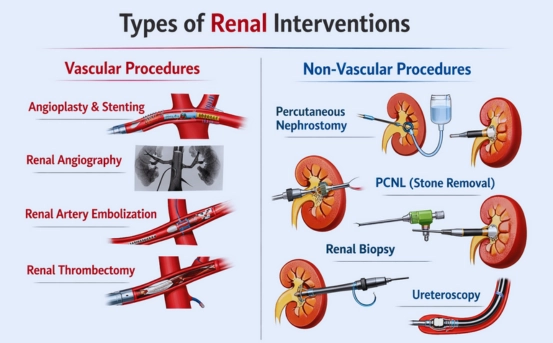
Renal interventions are medical procedures aimed at diagnosing or treating kidney-related conditions, including kidney stones, tumors, blockages, infections, or vascular abnormalities. These interventions can either involve blood vessels (vascular interventions) or the kidney parenchyma and urinary tract without involving major vessels (non-vascular interventions). Advances in medical technology, imaging techniques, and minimally invasive procedures have significantly reduced recovery times, improved safety, and enhanced the success rates of renal interventions. Vascular renal interventions target blood vessels associated with the kidneys. These procedures are crucial for restoring blood flow, treating aneurysms, or preventing complications related to impaired renal circulation.
Types of Vascular and Non-Vascular Renal Interventions
- Renal Angioplasty and Stenting :- Renal angioplasty is a minimally invasive procedure to widen narrowed or blocked renal arteries, often caused by atherosclerosis. A small balloon is inserted through a catheter to dilate the artery, and a stent is sometimes placed to keep it open.
Key Benefits:
- Improves blood flow to the kidneys
- Reduces hypertension caused by renal artery stenosis
- Minimally invasive with faster recovery
- Renal Artery Embolization :- Renal artery embolization involves deliberately blocking a renal artery using small particles, coils, or glue to reduce blood flow to a specific part of the kidney. It is commonly used for:
- Treating kidney tumors
- Controlling traumatic bleeding
- Managing arteriovenous malformations (AVMs)
Key Benefits:
- Minimally invasive alternative to surgery
- Preserves healthy kidney tissue
- Controls bleeding efficiently
- Endovascular Repair of Renal Aneurysms :- A renal aneurysm is an abnormal bulge in a kidney artery, which can rupture if untreated. Endovascular repair uses stent grafts to reinforce the arterial wall, preventing rupture.
Key Benefits:
- Reduces risk of life-threatening bleeding
- Avoids open surgery
- Shorter hospital stay
- Dialysis Access Creation :- Vascular interventions also include creating access points for hemodialysis, such as:
- Arteriovenous fistulas (AVF)
- Arteriovenous grafts (AVG)
These procedures ensure efficient blood flow during dialysis, crucial for patients with kidney failure.
Non-Vascular Renal Interventions
Non-vascular renal interventions focus on the kidney tissue, urinary tract, and drainage systems without directly involving major blood vessels. These procedures are often minimally invasive, using imaging guidance for precision.
- Percutaneous Nephrostomy :- Percutaneous nephrostomy is a procedure where a tube is inserted through the skin into the kidney to drain urine in cases of obstruction. Indications include:
- Kidney stones blocking urine flow
- Tumors causing obstruction
- Severe infections
Key Benefits:
- Relieves kidney pressure
- Prevents infection and kidney damage
- Minimally invasive
- Percutaneous Nephrolithotomy (PCNL) :- PCNL is a procedure used to remove large kidney stones. A small incision is made in the back, and instruments are inserted to fragment and extract stones.
Key Benefits:
- Removes large stones that cannot pass naturally
- Shorter recovery than open surgery
- Highly effective and safe
- Renal Biopsy :- Renal biopsy involves taking a small tissue sample from the kidney for diagnostic purposes. It helps identify:
- Glomerulonephritis
- Kidney infections
- Tumors
Key Benefits:
- Accurate diagnosis of renal conditions
- Guides treatment decisions
- Minimally invasive
- Tumor Ablation Techniques :- For patients with small kidney tumors, minimally invasive ablation techniques such as radiofrequency ablation (RFA) or cryoablation are used. These procedures destroy tumor tissue using heat or extreme cold.
Key Benefits:
- Preserves healthy kidney tissue
- Minimally invasive alternative to surgery
- Reduces hospital stay and recovery time
- Ureteral Stenting :- Ureteral stents are small tubes placed in the ureter to maintain urine flow from the kidney to the bladder. They are used in cases of:
- Ureteral obstruction from stones or tumors
- Post-surgical support
- Preventing kidney damage
Key Benefits:
- Ensures unobstructed urine flow
- Prevents kidney damage
- Temporary or long-term solutions
Choosing Between Vascular and Non-Vascular Interventions
The choice of intervention depends on the underlying kidney condition and patient-specific factors:
- Vascular interventions are preferred when the issue involves blood flow, arterial blockages, aneurysms, or AVMs.
- Non-vascular interventions are used for stones, tumors, infections, or diagnostic needs.
In many cases, both types of interventions may be combined to achieve the best outcome. For example, a patient with a kidney tumor and compromised blood supply may require both embolization and tumor ablation.
Advancements in Renal Interventions
Recent advances in imaging, robotic assistance, and minimally invasive technologies have transformed renal interventions:
- Real-time imaging ensures accurate catheter or needle placement
- Endoscopic techniques allow interventions with minimal incisions
- Robotic-assisted procedures improve precision and reduce complications
- Improved stent materials enhance long-term success and reduce infection risk
These innovations have made both vascular and non-vascular interventions safer, faster, and more effective than ever before.
Conclusion
Renal interventions, whether vascular or non-vascular, are essential tools for maintaining kidney health, managing disease, and improving patient outcomes. Understanding the types of interventions, their indications, and benefits helps patients make informed decisions and allows healthcare providers to tailor treatments to individual needs.
From renal angioplasty and embolization to nephrostomy and tumor ablation, modern renal procedures combine technology, precision, and patient-centered care to safeguard kidney function and overall health.